Best Free Tools to Cut AI Token Usage & Slash API Costs in 2026

Table of Contents
- 1. Token Waste vs. Token Usage: What Counts as an AI Token?
- 2. The 5 Major Token Leak Points in Modern AI Workflows
- 3. The Free AI Cost-Saving Master Stack (At a Glance)
- 4. Token Counters & Telemetry: Measure Before You Optimize
- 5. The 11 Best Free & Open-Source Tools to Cut Tokens
- 6. Production Architecture Patterns (Caching, Batching, Routing & Agent Guardrails)
- 7. Token Reduction Benchmark Matrix
- 8. The 7-Step Blueprint: Slash Your API Bill by 75% Today
- 9. Common Mistakes That Inflate Token Bills (And The Fix)
- 10. Frequently Asked Questions
1. Token Waste vs. Token Usage: What Counts as an AI Token?
AI API bills rarely spike because of a single catastrophic bug. Instead, they compound quietly through a persistent engineering tax: teams keep sending the exact same expensive context—long system instructions, unparsed binary documents, repetitive full chat transcripts, and chatty agent monologues—on every single API invocation.
The fastest route to cutting LLM expenditure is not blindly downgrading model intelligence. It is systematically measuring tokens, eliminating document clutter, caching stable system prefixes, routing straightforward queries to lightweight models, and capping runaway generative loops.
The FinOps Golden Rule: The cheapest token is the one you never send. The second cheapest is the one you send once and cache.
What Exactly Are You Billed For?
A token is a fragment of text—roughly 4 characters or 0.75 English words on average. However, never rely on raw word counts for FinOps budgeting because tokenizers split code syntax, whitespace, and punctuation with starkly different ratios. Frontier model providers (OpenAI, Anthropic, Google, DeepSeek) bill across five discrete token categories:
| Token Category | What Generates It | Cost Weight | Optimization Lever |
|---|---|---|---|
| Input Tokens | System prompt, user prompts, RAG documents, tool schemas, and conversation history. | Baseline rate ($1.50–$3.00/M on frontier) | Markdown conversion, LLMLingua pruning, RAG chunking |
| Output Tokens | The model's generated answer and internal reasoning / CoT tokens. | 3x to 5x Input Cost ($10–$15/M) | Caveman terseness, JSON schemas, strict max_tokens |
| Cached Input Tokens | Static prompt prefixes and reference context stored on the provider's server. | 50% to 90% Discount ($0.30/M on Claude) | Keep system instructions identical; put variables last |
| Tool-Call Tokens | JSON schema definitions for functions, terminal tool outputs, and API responses. | Billed as standard input | rtk CLI filtering, truncateToolOutput() |
| Retry Tokens | Regenerations caused by invalid JSON formatting, hallucinated schemas, or timeouts. | 100% Pure Financial Waste | Structured Outputs with schema validation |
The Core Equation: $\text{Token Invoice} = \text{Necessary Semantic Payload} + \text{Token Waste}$. In un-monitored environments, Token Waste accounts for 45% to 75% of total API charges.
2. The 5 Major Token Leak Points in Modern AI Workflows
Before deploying any optimization tool, diagnose where your application or workflow is hemorrhaging tokens. Modern AI workflows leak spend across five specific choke points:
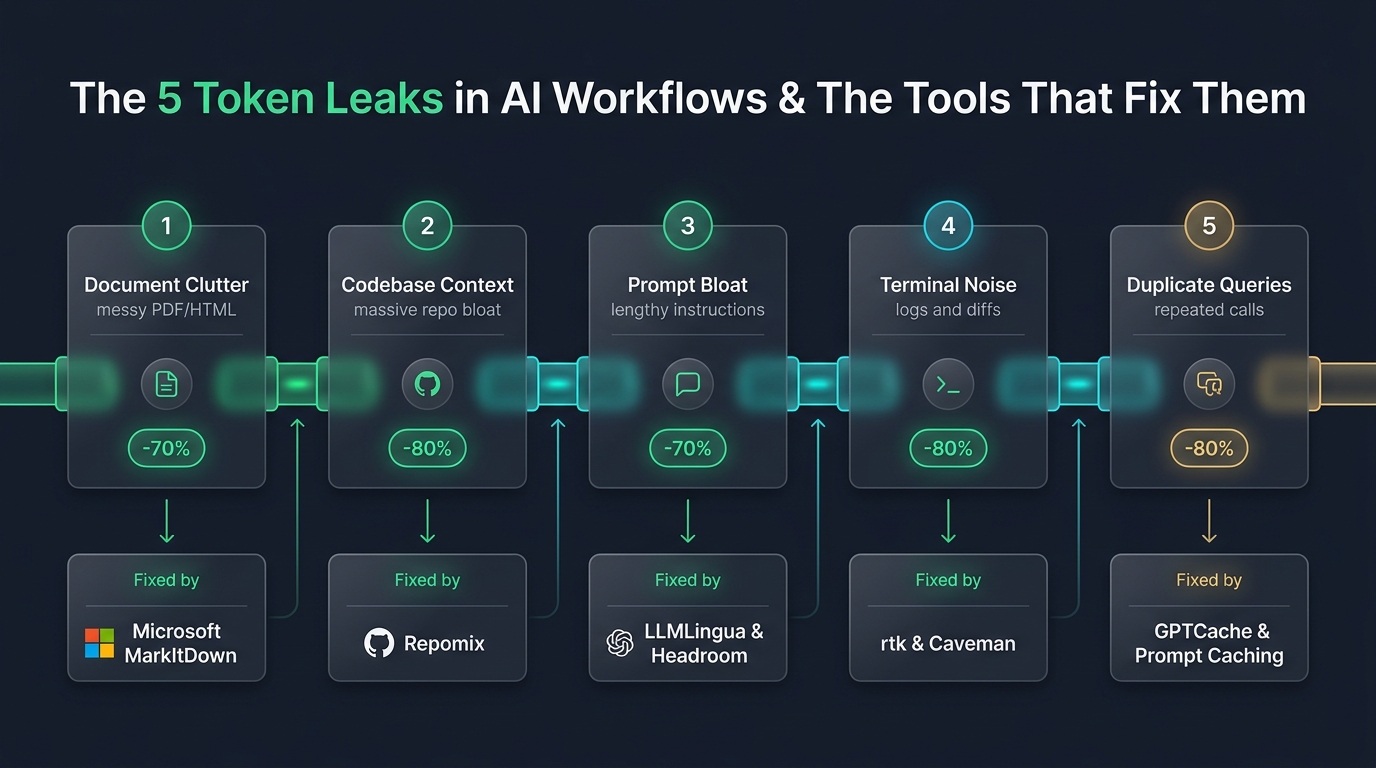
Leak 1: Document Formatting & Extraction Clutter
Uploading raw PDFs, Word documents (.docx), PowerPoint presentations, or scraped web HTML directly to Claude or ChatGPT. Hidden styling tags, CSS classes, table borders, and page breaks multiply token counts by 3x to 6x compared to clean text.
Leak 2: Monolithic Codebase Dumping
Pasting entire repositories or multi-thousand line files into an IDE agent (Cursor, Windsurf, or Claude Code) without stripping comments, lockfiles, or test fixtures.
Leak 3: Prompt Bloat & Repetitive Instruction Drift
Prompts that have organically expanded over months into 3,000-word monoliths packed with contradictory rules, outdated examples, and redundant filler words.
Leak 4: Terminal & Agent Tool Execution Noise
Autonomous agents running git status, npm test, or cat file in the terminal and ingesting hundreds of lines of identical compiler output into the conversational context.
Leak 5: Un-Cached Duplicate Requests & Unrouted Models
Paying flagship prices ($15/M tokens) to answer routine support questions, or re-sending static multi-megabyte system contexts on every single API call without utilizing native prompt caching.
3. The Free AI Cost-Saving Master Stack (At a Glance)
Before drilling into tool-specific configurations, use this reference matrix to identify the right cost-reduction technique for each architectural layer of your application:
| Tool / Technique | Primary Focus | License / Cost | Primary Saving Mechanism |
|---|---|---|---|
| Microsoft MarkItDown | PDF, DOCX, XLSX, HTML | MIT (Open Source) | Drops binary markup junk; 70%–85% reduction |
| rtk (Rust Token Killer) | CLI & Coding Agents | MIT (Open Source) | Strips compiler noise, git diffs, ANSI escape codes |
| Headroom & LLMLingua 2 | System & RAG Prompts | MIT / Local Proxy | Semantic entropy pruning; cuts prompt tokens by 60%–80% |
| Repomix (--compress) | Git Repository Context | MIT (Open Source) | Packs code into clean markdown, strips lockfiles & comments |
| Native Prompt Caching | Claude, OpenAI, Gemini | Free to Enable | Reuses stable prompt prefixes at 50% to 90% discount |
| Provider Batch APIs | Non-Real-Time Workloads | Free API Feature | 50% discount on OpenAI and Anthropic asynchronous jobs |
| GPTCache & Redis | Duplicate & Semantic FAQs | MIT / Free Tier | 100% token savings by serving identical/similar cached answers |
| LiteLLM Proxy | Model Routing & Budgets | MIT (Open Source) | Routes simple queries to micro models; enforces hard spend caps |
| Langfuse & OpenLIT | LLM Tracing & Telemetry | MIT / Apache 2.0 | Pinpoints exact expensive loops and agent retry storms |
| Caveman | Agent Output Formatting | MIT (Open Source) | Eliminates conversational filler; 65% output token savings |
| PromptStaging Calculator | FinOps Spend Modeling | 100% Free Browser Tool | Simulates multi-model costs and prompt caching savings instantly |
4. Token Counters & Telemetry: Measure Before You Optimize
You cannot optimize what you do not measure. Before rewriting prompts, inspect the real token split across your workflows using dedicated token counters:
- OpenAI Tiktoken (Python / Rust): The gold-standard BPE tokenizer for GPT-4o, o1, and embeddings. Use it in CI/CD tests to detect prompt regressions.
- Anthropic Token Counter API: Estimates exact Claude input tokenization, accounting for XML system prompt formatting and tool schema packaging.
- Google Tokenizer Tools: Essential for Gemini 1.5/2.5 Pro architectures, where token splitting differs from OpenAI byte-pair encoding.
- VS Code Live Token Counters: Extensions like
bedirt.gpt-token-counter-livedisplay real-time token tallies in your status bar while authoring prompts, system instructions, or AGENTS.md runbooks. - Browser Counters: Instant utilities like InstantTools and our client-side PromptStaging generator for rapid ad-hoc verification.
Production Token-Logging Blueprint
Instrument every model call with structured usage metadata. Here is a minimal TypeScript/JavaScript pattern to log token usage and calculate realized cache hit rates:
workflow: string;
model: string;
inputTokens: number;
outputTokens: number;
cachedInputTokens?: number;
retries: number;
costUsd: number;
};
function logUsage(usage: LlmUsage) {
const cacheHitRate = usage.cachedInputTokens
? (usage.cachedInputTokens / usage.inputTokens)
: 0;
console.log(JSON.stringify({
event: "llm_usage",
...usage,
cacheHitRate: Number(cacheHitRate.toFixed(4)),
timestamp: new Date().toISOString()
}));
}
Without per-feature logging, teams frequently waste hours micro-optimizing an interactive chat prompt while an unmonitored background document summarizer burns 80% of the monthly invoice.
5. The 11 Best Free & Open-Source Tools to Cut Tokens
Here are the top 11 tools actively used by production teams and vibe coders to eliminate token waste, categorized by the exact layer they optimize:
1. Microsoft MarkItDown (Best for Document & File Cleanup)
License: MIT • Platform: Python CLI / Library • GitHub: microsoft/markitdown (35,000+ Stars)
If you upload PDFs, Word documents, PowerPoint decks, Excel spreadsheets, or HTML exports to LLMs, MarkItDown is your first line of defense. Built by Microsoft, this open-source utility converts complex binary office files into pristine, structured Markdown before they ever touch an LLM.
markitdown annual_report.pdf > clean_report.md
Why it cuts waste: A 20-page corporate PDF can easily consume 45,000 tokens due to embedded vector paths, font metadata, and table layout XML. Converting it with MarkItDown extracts pure text and clean Markdown tables, dropping the token footprint down to ~8,000 tokens—an immediate 80%+ savings.
2. Headroom (Best for Universal Prompt & Context Compression)
License: Open-Source / Local-First • Platform: Local Proxy & CLI • Origin: Ex-Netflix Infrastructure Engineer
Built by a former senior Netflix distributed systems engineer, Headroom acts like an intelligent "zip file" layer for AI prompts. Operating as a zero-latency local proxy, it intercepts prompts, web search dumps, and conversational history, compressing the semantic context by 60% to 95% before forwarding it to OpenAI, Anthropic, or Gemini.
Key Feature: Headroom can run as a background proxy on your machine, instantly slashing token bills across Claude Desktop, Cursor, and custom Python agent scripts without changing your code.
3. rtk (Rust Token Killer) (Best for Coding Agents & Terminal Noise)
License: MIT • Platform: High-Performance Rust CLI • GitHub: rtk-ai/rtk
If you use autonomous coding agents like Claude Code, Cursor, or terminal copilots, you know that agents burn hundreds of thousands of tokens reading verbose terminal outputs: git diff dumps, package installation logs, and npm test stack traces.
rtk (Rust Token Killer) is a lightning-fast CLI proxy written in Rust that intercepts and filters terminal outputs:
# Automatically strips boilerplate terminal noise before agent ingestion
rtk exec "npm test"
Real-world payoff: It removes duplicate stack frames, strips repetitive ANSI color escape codes, and condenses git diffs, saving 60% to 90% on multi-turn coding sessions.
4. Microsoft LLMLingua & LLMLingua-2 (Best for Semantic Prompt Compression)
License: MIT • Platform: Python / PyTorch • GitHub: microsoft/LLMLingua
Developed by Microsoft Research, LLMLingua uses small, ultra-fast language models (like fine-tuned RoBERTa) to calculate the token entropy of your prompt. It deterministically prunes low-entropy, low-information tokens (filler prepositions, redundant adjectives, duplicated syntax) while preserving the core semantic instruction.
Benchmark Performance: Microsoft's research papers demonstrate up to 3x–5x compression on general prompts and up to 20x on long RAG documents with less than a 1% impact on task performance.
5. Repomix (Best for Codebase Context Packaging)
License: MIT • Platform: Node.js / CLI • Website: repomix.com
When asking an AI model to audit or refactor an entire application, developers frequently upload the whole repository. Repomix is the developer standard for packing codebases into a single AI-friendly Markdown file.
Using the built-in --compress flag automatically strips lockfiles, minifies whitespace, removes redundant comments, and generates a compact file tree, slashing your repository's token footprint by roughly 70%.
6. Caveman (Best for Cutting Verbose Agent Output)
License: MIT • Platform: Claude Code Skill & Agent Proxy • GitHub: juliusbrussee/caveman
Output tokens are typically 3x to 5x more expensive than input tokens. Yet most models are trained to be chatty, producing polite introductory paragraphs and redundant summaries.
Caveman is an open-source skill that forces coding agents to communicate in terse, compressed, ultra-dense prose. It leaves reasoning tokens intact while cutting output verbosity by an average of 65%.
7. GPTCache (Best for Semantic Query Caching)
License: MIT • Platform: Python / Redis / Milvus • GitHub: zilliztech/GPTCache
Answering the exact same question twice is 100% pure financial waste. GPTCache is a semantic caching layer for LLMs. Instead of relying on exact string matches, it converts incoming queries into vector embeddings. If a new user query matches the semantic intent of a previously answered query above a defined threshold (e.g., 0.92 cosine similarity), it serves the cached response instantly.
Result: Zero latency, zero API calls, and a 100% token savings on repetitive application queries.
8. Native Prompt Caching (The Essential 2026 Architectural Move)
Supported Providers: Anthropic (Claude 3.5/3.7), OpenAI (GPT-4o), Google (Gemini 1.5/2.5)
While not a third-party library, mastering Native Prompt Caching is the single highest-ROI technique in 2026. Both Anthropic and OpenAI automatically cache identical prompt prefixes over 1,024 tokens.
- Anthropic Claude: Cached prompt reads cost 90% less than standard input tokens ($0.30/M vs $3.00/M on Sonnet).
- OpenAI GPT-4o: Cached prompt reads receive an automatic 50% discount.
- Google Gemini: Context caching offers up to 75% cost reduction on long static corpora.
The Secret: To achieve a 95%+ cache hit rate, always structure your prompt with static elements (system instructions, documentation, AGENTS.md rules) at the absolute top, and place dynamic user variables at the very end.
9. LiteLLM (Best for Cost Routing & Spend Ceilings)
License: MIT • Platform: Python / Proxy • GitHub: BerriAI/litellm
LiteLLM provides a unified OpenAI-compatible API interface to call 100+ LLMs (OpenAI, Anthropic, Gemini, Groq, Bedrock). It allows you to enforce global budget ceilings, track per-user token consumption, and configure smart model routing—automatically sending simple classification tasks to ultra-cheap models (like Gemini Flash or GPT-4o-mini) and reserving expensive reasoning models only for high-complexity queries.
10. Langfuse & OpenLIT (Best for Finding Where Your Tokens Leak)
Licenses: Langfuse (MIT / Open-Source) • OpenLIT (Apache 2.0 / OpenTelemetry Native)
You cannot optimize what you do not measure. Tools like Langfuse and OpenLIT provide real-time observability across all LLM requests. They display flame graphs of your agent workflows, highlighting the exact prompt, tool call, or RAG retrieval chunk that generated the highest token expense.
11. PromptStaging AI Cost & Token Calculator (Free Browser Utility)
License: 100% Free / Client-Side • URL: ai-cost-calculator.html
Curious how much token compression will actually save your business in dollars and cents? Our free browser-only AI Cost Calculator lets you simulate token volumes, compare pricing across 8 frontier models, and calculate exact dollar savings under 50% to 90% prompt caching discounts—without sending your data to any server.
6. Production Architecture Patterns (Caching, Batching, Routing & Agent Guardrails)
Cutting tokens at scale requires combining discrete tools into robust system patterns. Implement these architectural countermeasures across your backend pipelines:
6.1 Structuring Cache-Friendly Prompts (The Static Prefix Rule)
Prompt caching reuses the key-value (KV) attention cache computed on provider clusters. However, cache lookup is strictly prefix-based: any modification in the first 1,000 tokens invalidates the entire cache for subsequent turns.
Research across frontier providers shows that effective prompt caching slashes API costs by 41% to 80% while reducing time-to-first-token (TTFT) by 13% to 31%.
| Component | Cache-Friendly (High Hit Rate) | Cache-Breaking (Zero Hit Rate) |
|---|---|---|
| System Instructions | Identical, standardized markdown prompt at the top | Dynamic per-user wording or session IDs at the start |
| Tool & Function Schemas | Fixed order and stable schema definitions | Dynamically reordered or conditionally removed schemas |
| Reference Documents | Static manuals and docs positioned before user input | Interleaved with dynamic user conversation turns |
| Timestamps & IDs | Omitted or placed at the absolute end of the user prompt | Embedded inside the system prompt header |
| Few-Shot Examples | Fixed, standardized golden exemplars | Regenerated dynamically per user request |
Copy-Paste Cache Blueprint:
You are an expert enterprise FinOps automation assistant for Acme Systems.
## Core Rules
- Answer strictly using provided product documentation.
- If the answer cannot be verified from context, reply: "DATA_UNAVAILABLE".
- Never guess formulas or estimate financial figures.
## Tool Schemas
[STABLE_FUNCTION_DEFINITIONS]
## Reference Documentation
[STABLE_POLICY_AND_API_DOCUMENTATION]
---
# DYNAMIC USER PAYLOAD — Placed strictly at the end
User Request: How do I export quarterly variance reports to CSV?
6.2 Semantic Caching Safety Boundaries & Redis Integration
While prompt caching requires identical prefixes, semantic caching stores previous question-answer pairs in a vector database (like Redis Stack or Qdrant). When a new user query arrives, the system computes its vector embedding and checks for near-identical semantic meaning.
According to Snowflake AI research, semantic caching reduces model API calls by up to 68.8% on customer-support and documentation workloads.
- Safe to Cache Semantically: General FAQs, product usage guidelines, document summaries, classification tasks, and onboarding assistance.
- Unsafe (Bypass Cache): Real-time inventory queries, dynamic pricing, user-specific account data, financial audits, or medical/legal advice where minor semantic drift causes material harm.
6.3 Cutting Non-Urgent Spend in Half with Provider Batch APIs
If your application does not require a sub-second response, never send it to a real-time endpoint. Major providers offer dedicated Batch APIs that process requests asynchronously within 24 hours at an automatic 50% discount across both input and output tokens:
- OpenAI Batch API: 50% discount on GPT-4o, GPT-4o-mini, and text embeddings.
- Anthropic Message Batches API: 50% discount on Claude 3.5 Sonnet, 3.5 Haiku, and 3.7 Sonnet.
SLA-Based Routing Rule:
return callRealTimeLlm(request); // Full price, sub-second response
} else {
return queueBatchJob(request); // 50% discount, 24h completion window
}
6.4 Model Routing by Task Complexity
Calling a senior reasoning model (like Claude 3.7 Sonnet or OpenAI o1) to classify incoming customer support tickets is equivalent to hiring a senior software architect to rename CSS variables.
Use a fast, ultra-cheap model (such as Gemini 2.0 Flash at $0.10/M tokens) as an initial router to categorize intent before delegating to heavier engines:
A = SIMPLE_EXTRACTION (Regex, dates, formatting) -> Gemini Flash / GPT-4o-mini
B = FAQ_WITH_RETRIEVAL (Product support) -> Small model + RAG
C = CODE_OR_AGENT_TASK (Refactoring, debugging) -> Claude Sonnet / Coding model
D = COMPLEX_REASONING (Financial auditing, math) -> Frontier reasoning model
Return JSON only:
{
"route": "A" | "B" | "C" | "D",
"confidence": 0.0 - 1.0,
"reason": "one sentence explanation"
}
6.5 RAG Anti-Bloat Guidelines: Stop Dumping Entire PDFs
One of the most expensive antipatterns in modern AI engineering is stuffing entire 200-page policy manuals into the system context on every call. Instead of passing 80,000 tokens of raw prose:
- Chunk semantically: Slice documents into 300–500 token semantic sections rather than arbitrary character splits.
- Retrieve precision context: Retrieve only the top 3 to 5 relevant chunks (1,500 to 2,500 tokens total).
- Deduplicate embeddings: Cache chunk embeddings in pgvector, Qdrant, or Chroma so unchanged documents are never re-embedded.
6.6 Agent Guardrails & Tool Output Truncation
Autonomous coding agents (Cursor, Windsurf, Claude Code) are notorious for runaway token spend because a single human instruction can trigger multi-turn loops. Protect your API keys with explicit budget guardrails and defensive output truncation:
const AGENT_BUDGET = {
maxModelCallsPerTask: 8,
maxTotalInputTokens: 35000,
maxTotalOutputTokens: 4000,
maxToolResultTokens: 4000,
maxRetries: 2
};
// Defensive Tool Output Truncation Helper
function truncateToolOutput(text, maxTokens = 2000) {
const approximateTokens = Math.ceil(text.length / 4);
if (approximateTokens <= maxTokens) return text;
const headChars = Math.floor(maxTokens * 4 * 0.7);
const tailChars = Math.floor(maxTokens * 4 * 0.3);
return [
text.slice(0, headChars),
`\n\n[... TRUNCATED ${approximateTokens - maxTokens} TOKENS FOR BUDGET ...]\n\n`,
text.slice(-tailChars)
].join("");
}
6.7 Output Limits & Strict JSON Schema Contracts
Because output tokens cost 3x to 5x more than input tokens, allowing an LLM to generate unstructured prose with polite filler phrases is pure monetary waste. Enforce strict JSON schemas with additionalProperties: false and capped string lengths:
"type": "object",
"additionalProperties": false,
"required": ["status", "category", "summary"],
"properties": {
"status": { "type": "string", "enum": ["APPROVED", "REJECTED", "REVIEW"] },
"category": { "type": "string", "enum": ["BILLING", "AUTH", "INFRA", "OTHER"] },
"summary": { "type": "string", "maxLength": 160 }
}
}
Enforcing structured outputs eliminates conversational chit-chat, cuts response lengths from 400 tokens to under 50 tokens, and completely prevents retry loops caused by malformed JSON.
6.8 Rolling Context Compaction Prompt
In multi-turn chat applications, resending the entire raw transcript causes token costs to grow quadratically with each turn ($O(N^2)$). Instead, run a periodic compaction step every 8 turns to compress conversational state:
Compress the conversational transcript into a concise Markdown state artifact.
Preserve active constraints, user decisions, verified variables, and next actions.
Strip out greetings, pleasantries, failed tool calls, and repetitive explanations.
Output format:
## Active Objective
## Hard Constraints
## Key Decisions Made
## Pending Questions & Next Action
7. Token Reduction Benchmark Matrix
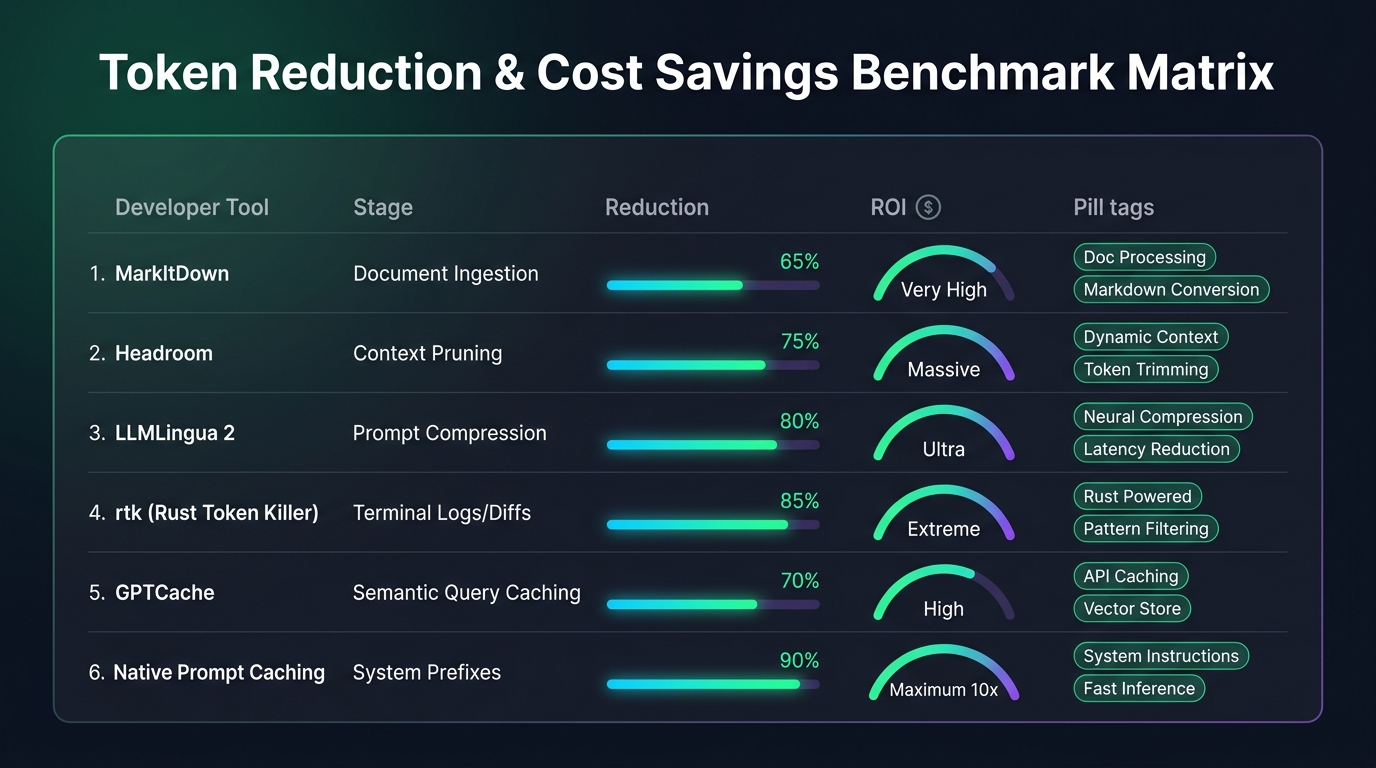
To help engineering leads prioritize their optimization roadmap, review this empirical comparison of token reduction rates and primary implementation targets across all 11 tools:
| Optimization Method | Where It Runs | Cost Reduction | Latency Impact | Best Example Tool |
|---|---|---|---|---|
| Document Markdown Cleaning | Local Pre-Processing | 70% – 85% | Faster generation | Microsoft MarkItDown |
| Entropy Prompt Pruning | Local / Gateway Proxy | 60% – 80% | +5ms processing | Headroom / LLMLingua |
| Terminal Output Filtering | Local CLI Shell | 60% – 90% | Instant | rtk (Rust Token Killer) |
| Native Provider Prefix Caching | Cloud Provider Cluster | 50% – 90% | Up to 80% Faster TTFT | Claude / OpenAI Cache |
| Provider Batch Processing | Async Provider Queue | 50% Flat Discount | Async (Up to 24h) | OpenAI / Anthropic Batch |
| Semantic Response Caching | Edge Gateway / Redis | 100% (On Cache Hit) | Zero Model Latency | GPTCache / Redis |
8. The 7-Step Blueprint: Slash Your API Bill by 75% Today
Do not attempt to deploy every tool simultaneously. Follow this systematic, engineering-tested implementation order:
- Measure Usage by Feature: Add token-logging telemetry to identify the 20% of workflows driving 80% of spend.
- Clean All Input Documents: Sanitize raw PDFs and Word docs into clean Markdown with
markitdown file.pdf > clean.md. - Cap Output with Strict Schemas: Set sensible
max_tokensbudgets and use JSON schemas withadditionalProperties: false. - Anchor Prefixes for Native Caching: Keep system prompts identical and place dynamic user variables at the very end to trigger 50%–90% caching discounts.
- Filter Terminal Noise for Coding Agents: Install
rtkandcavemanin your developer environments to eliminate compiler chatter. - Move Non-Urgent Work to Batch APIs: Route document extractions, nightly summaries, and dataset evaluations to asynchronous Batch endpoints for a 50% discount.
- Simulate Savings in Real Time: Model your expected monthly savings using our free client-side calculator.
💰 Calculate Your Token Savings Now
Test your exact request volumes and model combinations in your browser with zero data tracking:
9. Common Mistakes That Inflate Token Bills (And The Fix)
| Frequent Mistake | Why It Burns Money | The Engineering Fix |
|---|---|---|
| Sending Full Conversational History | Input tokens grow quadratically ($O(N^2)$) on every chat turn. | Use rolling state compaction prompts every 8 turns. |
| Inserting Dynamic Variables into System Prompts | Invalidates provider prefix caching on every request. | Keep system prompts 100% static; put user IDs and dates at the end. |
Omitting max_tokens on Open-Ended Calls |
Models generate redundant polite chatter and preamble. | Set task-specific output limits (e.g., 100 tokens for classification). |
| Blindly Retrying Malformed JSON | You pay for every failed completion and hallucinated tag. | Enforce Structured Outputs with schema-locked JSON schemas. |
| Uploading Raw Binary PDFs | Embedded font vectors and CSS classes inflate tokens by 3x–6x. | Convert files with Microsoft MarkItDown before feeding models. |
| Using Frontier Reasoning Models for Simple Routing | Paying $15/M tokens for basic keyword or sentiment extraction. | Route simple classification to Gemini Flash or GPT-4o-mini ($0.15/M). |
| Allowing Coding Agents Unbounded Terminal Access | Terminal logs, test failures, and git diffs dump 100,000+ tokens. | Filter CLI commands through rtk and truncate tool outputs. |
10. Frequently Asked Questions
What is the difference between token usage and token waste?
Token usage represents the actual semantic information necessary to solve a user's task. Token waste consists of uninformative overhead: document formatting tags, HTML headers, repetitive conversational apologies, uncompressed terminal logs, and repeated identical API queries.
What counts as an AI token and how are they billed?
Tokens are text chunks of roughly 4 characters or 0.75 words. LLM providers bill across five categories: Input tokens (prompts and context), Output tokens (model generation and reasoning), Cached input tokens (reused static prefixes at 50%–90% discounts), Tool-call tokens (function schemas and returns), and Retry tokens (failed generations or parsing errors).
How does Native Prompt Caching differ from semantic caching like GPTCache?
GPTCache is a client-side semantic cache that intercepts queries before they reach an LLM; if a similar query exists, it returns the cached completion for zero cost. Native Prompt Caching (available in Claude 3.5/3.7, GPT-4o, and Gemini) operates on the AI provider's inference cluster, caching identical prefix tokens (like system prompts or large documentation) and offering a 50% to 90% discount on prompt read tokens.
Does compressing prompts with LLMLingua hurt model reasoning or accuracy?
Research from Microsoft demonstrates that LLMLingua 2 removes low-entropy and redundant tokens while maintaining semantic fidelity, yielding up to 3x–5x compression with minimal to zero degradation on downstream benchmark tasks.
How much can prompt caching save in production?
Published empirical benchmarks report 41% to 80% total API cost reductions and 13% to 31% faster time-to-first-token (TTFT). On Anthropic Claude, cached input tokens are billed at a 90% discount ($0.30/M vs $3.00/M), while OpenAI offers a 50% discount and Google Gemini offers up to 75% savings.
Which tool provides the fastest ROI for developers using Cursor or Claude Code?
For coding agents, rtk (Rust Token Killer) and Caveman offer the most immediate savings. They filter verbose terminal noise, git diffs, and package manager test output before it is ingested by the agent's context window, cutting per-turn token consumption by 60% to 90%.