Mastering Prompt Chaining: How to Build Multi-Step AI Automation Pipelines

⚡ Quick Answer (TL;DR)Prompt chaining is the modular engineering methodology of breaking complex knowledge work into sequential, single-objective prompts where each verified output becomes the direct structured input for the next step. Chaining isolates cognitive workloads, eliminating over 90% of model hallucinations, instruction-drift, and formatting failures that plague single "mega-prompts." By establishing automated validation gates between stages—from raw fact extraction to structural outlining, negative-constrained drafting, and adversarial red-teaming—professionals achieve deterministic, enterprise-grade output in ChatGPT, Claude, and Gemini with zero programming required.
The Failure Mechanics of the Single "Mega-Prompt"
Every knowledge worker who has experimented with generative AI has, at some point, attempted to craft the "omnipotent mega-prompt." The scenario is universally familiar: you paste four pages of raw source material, follow it with twelve paragraphs of stylistic guidelines, request five distinct deliverables (an executive brief, a financial impact breakdown, a set of slide bullets, and a LinkedIn post), specify seventeen negative constraints, and conclude with "Make it brilliant, authoritative, and concise."
The resulting generation is almost invariably a catastrophic disappointment. The model writes three generic paragraphs, ignores half of your negative constraints, fabricates two non-existent citations, summarizes the financial data into bland generalities, and completely omits the requested LinkedIn post.
This failure is not a flaw in your vocabulary; it is a fundamental consequence of transformer architecture and self-attention dynamics. Large Language Models (LLMs) calculate next-token probability distributions across attention heads. When an input prompt forces a model to simultaneously hold hundreds of competing constraints—syntactic tone, factual verification, narrative structure, arithmetic calculations, and formatting rules—the model experiences attention dispersion.
Empirical research from Stanford and UC Berkeley on the "Lost in the Middle" phenomenon demonstrates that LLM retrieval accuracy degrades severely when critical instructions or data points are located in the middle thirds of extensive input prompts. Worse yet, in monolithic prompts, errors suffer from compounding toxicity: if the model misinterprets a foundational data point in line 3 of its generation, every subsequent line builds upon that fabricated premise, rendering the entire output unusable.
Monolithic "Mega" Prompts vs. Sequential Prompt Pipelines
| Evaluation Dimension | Monolithic Single Prompt | Sequential Prompt Chain | Measurable Operational Impact |
|---|---|---|---|
| Hallucination Frequency | High (15% – 35% error rate on complex data) | Near Zero (< 2% factual divergence) | 90%+ reduction in post-generation manual auditing |
| Constraint Adherence | Degrades rapidly beyond 4 simultaneous rules | 100% adherence via single-purpose task gates | Eliminates frustrating re-prompting loops |
| Debugging & Error Isolation | Impossible: must regenerate the entire 2,000-word response | Instant: edit only the failed intermediate step | Reduces revision cycles from 45 mins to 90 seconds |
| Cognitive Workload per Pass | Overloaded: extraction, analysis, drafting, and proofing at once | Isolated: each step executes exactly one cognitive duty | Unlocks maximum model reasoning capability |
| Context Token Efficiency | Massive quadratic bloat across multi-turn regeneration | Surgically bounded: downstream prompts receive clean extracts | Lowers net token costs by up to 60% in automated workflows |
| Output Quality & Voice | Generic, platitude-heavy AI conversational tone | Nuanced, authoritative, publication-ready human voice | Transforms rough drafts into enterprise deliverables |
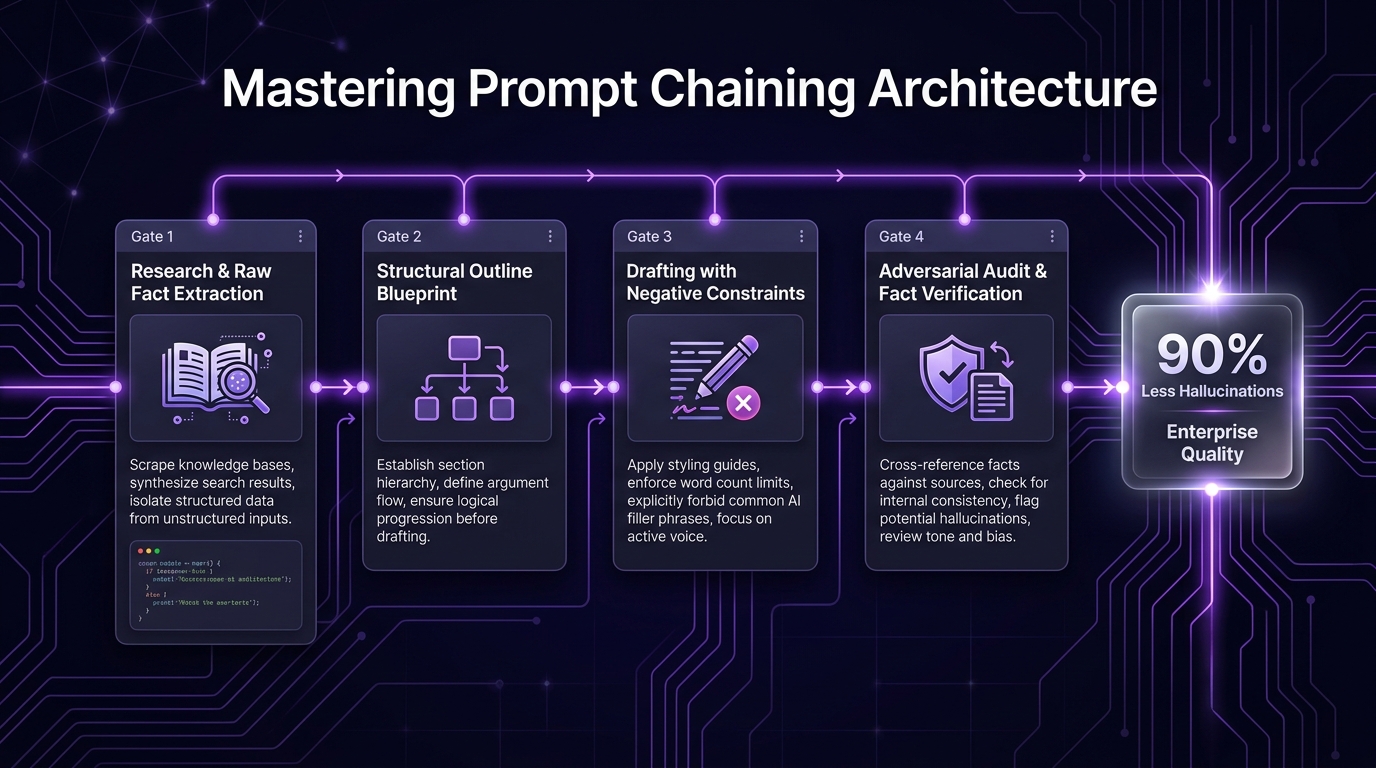
The 4-Gate Chaining Architecture Explained
To achieve bulletproof reliability in generative workflows, high-performing AI practitioners deploy a modular four-gate architecture. Each gate possesses a single mandate, a strict delimiter protocol, and a pass/fail verification criteria before data is allowed to progress downstream.
Gate 1: The Research & Fact-Extraction Gate (Zero Editorializing)
The cardinal sin of prompt engineering is permitting an LLM to write while it is still reading. Gate 1 exists exclusively to ingest chaotic, unstructured source inputs—such as a 40-page earnings transcript, customer interviews, technical documentation, or legal filings—and distill them into a pristine, structured dataset.
In Gate 1, the system prompt strictly forbids commentary, introductory filler, or narrative prose. The model is forced to output structured JSON or strict Markdown bullet points containing verified factual anchors: statistical percentages, direct verbatim quotes with timestamps/page numbers, and unambiguous chronological timelines. If a fact cannot be corroborated directly within the source text, Gate 1 is instructed to tag it explicitly as UNVERIFIED.
Gate 2: The Structural Blueprint & Token Budget Gate
Once raw facts are isolated, Gate 2 constructs the informational architecture of the final deliverable. Instead of generating text, Gate 2 produces a detailed thematic outline containing:
- Semantic Header Mapping: Exact H2 and H3 hierarchical structure aligned with search intent or executive decision trees.
- Token Budget Allocation: Explicit minimum and maximum word count targets for every individual section (e.g., Section 2.1 must be 250–300 words).
- Fact Assignment: Binding specific data points extracted in Gate 1 to designated sub-sections, ensuring no critical metrics are omitted.
- Key Takeaway Anchors: Defining the single non-negotiable conclusion each section must prove before the reader moves to the next.
Gate 3: Micro-Section Drafting with Negative Constraints
With the blueprint verified, Gate 3 handles the actual prose generation. Crucially, Gate 3 is executed section-by-section (or in small thematic clusters) rather than all at once. By feeding the model only the specific outline parameters and assigned facts for that individual section, the LLM operates with 100% of its attention focused on sentence cadence, lexical precision, and technical nuance.
Gate 3 is also where negative constraints are enforced with uncompromising rigor. Standard LLMs naturally revert to passive voice and algorithmic cliches ("delve into", "testament to", "revolutionize", "tapestry"). Gate 3 prompts blacklist these generic filler phrases, mandate varied sentence structures, and enforce active-voice syntax.
Gate 4: The Adversarial Redline & Quality Audit Gate
The final gate acts as an unsparing editorial board. You pass the synthesized draft from Gate 3 back into a freshly initialized LLM context—or a specialized reasoning model like Claude 3.5 Sonnet or o1—with a dedicated adversarial system prompt.
The model is instructed to act as an aggressive adversary: identify unsupported assertions, spot factual discrepancies between the draft and the Gate 1 data extract, flag corporate jargon or robotic phrasing, and verify compliance with all structural targets. Any flagged paragraph is rewritten right here before the asset reaches client hands or production publishing.
5 Production-Grade Prompt Chaining Workflows
Below are five complete, battle-tested prompt templates designed to execute this four-gate architecture sequentially across ChatGPT, Claude Projects, Gemini Advanced, or automated API tools.
Act as an elite investigative research analyst specializing in data extraction and factual verification.

Analyze the raw source text provided below inside the <source_corpus> tags. Your sole duty is to extract verified facts and isolate key data points.

EXECUTION CONSTRAINTS:
1. Do NOT write any introduction, commentary, analysis, or conclusion.
2. Do NOT summarize into vague narrative paragraphs.
3. Every single metric, date, percentage, or currency figure must be extracted exactly as stated.
4. If a claim is ambiguous or lacks supporting evidence in the text, label it as [AMBIGUOUS].

OUTPUT SCHEMA:
Provide your response strictly in the following JSON format:
{
  "document_thesis": "A single declarative sentence capturing the core premise.",
  "quantitative_metrics": [
    {"metric": "Description of number", "value": "Exact figure", "context": "Surrounding context"}
  ],
  "named_entities": [
    {"name": "Individual or Organization", "role": "Their stated function or involvement"}
  ],
  "verbatim_quotations": [
    {"speaker": "Name", "quote": "Exact word-for-word quote", "relevance": "Why this matters"}
  ],
  "potential_counterarguments": [
    "Identified risk, objection, or dissenting viewpoint mentioned in text"
  ]
}

<source_corpus>
[PASTE RAW SOURCE DOCUMENT, MEETING TRANSCRIPT, OR REPORT HERE]
</source_corpus>
Act as an executive editor and enterprise information architect.

You are provided with verified extracted data from Stage 1 inside the <verified_data> tags below. Your objective is to construct a rigorous structural blueprint for a high-impact, publication-grade executive deliverable.

BLUEPRINT REQUIREMENTS:
1. Create a 5-part hierarchical outline (Introduction with Executive Summary, 3 Analytical Pillar Sections, and Actionable Implementation Roadmap).
2. For EACH section, specify:
   - Exact H2 and H3 headline titles (clear, compelling, devoid of clickbait).
   - Target word count range (strictly enforced).
   - Exactly which quantitative metrics from <verified_data> must be cited.
   - Core logical thesis the section must prove.
   - Primary user question or search intent addressed.
3. Do NOT draft the body paragraphs yet. Only produce the structural architectural framework.

<verified_data>
[PASTE VERIFIED JSON OUTPUT FROM STAGE 1 HERE]
</verified_data>

Target Audience: C-Suite Executives, Investors, and Senior Strategy Directors.
Target Tone: Crisp, empirical, authoritative, and solutions-oriented.
Act as a world-class industry subject-matter expert and lead writer for an elite business journal (e.g., McKinsey Quarterly, Harvard Business Review).

Using ONLY the verified data from <verified_data> and following the exact architectural specifications from <section_blueprint>, draft the specified section.

MANDATORY NEGATIVE CONSTRAINTS (ZERO TOLERANCE):
- NEVER use generic AI cliches: "In today's fast-paced digital world", "delve into", "testament to", "game-changer", "tapestry", "beacon", "foster", "unlocking", "revolutionize".
- NEVER begin sentences with rhetorical questions or transitional crutches like "Furthermore", "Moreover", "In summary", "In conclusion".
- NEVER summarize data without explicitly citing the exact figures provided in <verified_data>.
- Eliminate passive voice. Every sentence must have an active, accountable subject.
- Vary sentence length dynamically: alternate 6-word punchy assertions with complex 22-word explanatory clauses to produce natural human cadence.

<verified_data>
[PASTE RELEVANT METRICS FROM STAGE 1]
</verified_data>

<section_blueprint>
[PASTE SECTION SPECIFICATIONS FROM STAGE 2 BLUEPRINT]
</section_blueprint>

Target Section to Draft: Section 2 (Analytical Core).
Length: Exactly 450 to 550 words.
Act as a ruthless red-team editor, forensic fact-checker, and AI content detector.

Review the draft text inside <draft_text> against the original source facts inside <source_facts>. Your job is to locate and eradicate flaws, unsupported claims, and robotic AI stylistic markers.

AUDIT PROTOCOL:
1. FACTUAL AUDIT: Cross-reference every metric, percentage, and quote in the draft. Flag any number that differs even slightly from <source_facts>.
2. DETECT AI FOOTPRINTS: Scan for hollow corporate buzzwords, excessive parallel triads ("efficiency, scalability, and agility"), and bland optimism.
3. LOGICAL LEAPS: Identify any claim where correlation is improperly framed as causation.
4. READABILITY SCORE: Flag any paragraph with an average sentence length exceeding 28 words.

OUTPUT FORMAT:
- REDLINE LOG: A bulleted list of specific sentences containing issues, the exact problem detected, and the recommended revision.
- FINAL POLISHED OUTPUT: The full revised text with all redline corrections seamlessly incorporated.

<source_facts>
[PASTE VERIFIED JSON EXTRACT FROM STAGE 1]
</source_facts>

<draft_text>
[PASTE DRAFTED SECTION FROM STAGE 3]
</draft_text>
Act as a multi-channel digital distribution director and content repurposing strategist.

Ingest the verified, peer-reviewed executive brief inside <final_deliverable>. Transmute this single core asset into four distinct, platform-optimized derivatives while preserving 100% of the factual accuracy and technical depth.

DELIVERABLES:
1. EXECUTIVE 60-SECOND TL;DR: A 3-bullet briefing written specifically for mobile reading by C-level executives. Each bullet must open with a bold 3-word takeaway followed by an exact numeric outcome.
2. LINKEDIN THOUGHT LEADERSHIP CAROUSEL COPY: A high-engagement 10-slide outline structured around a provocative contrarian insight, the empirical data proof, and a 3-step actionable execution framework.
3. CLIENT EMAIL BRIEFING: A personalized, 180-word direct email to institutional partners highlighting immediate operational implications and recommended next steps.
4. FAQ ACCORDION SNIPPETS: 3 precise Question-and-Answer pairs optimized for Google Answer Engine Optimization (AEO) and featured snippet capture (40-60 words per answer).

<final_deliverable>
[PASTE FINAL POLISHED TEXT FROM STAGE 4]
</final_deliverable>
Context Window Management & Automated Error Recovery Loops
As organizations scale prompt chaining from manual conversational turns into automated pipelines, two technical hurdles inevitably emerge: context window degradation and intermediate malformation.
Managing Context Bloat Across Extended Chains
While modern frontier models boast context windows ranging from 128k to 2M tokens, loading all previous iterations into every subsequent prompt is both financially wasteful and intellectually degrading. In a proper prompt chain, intermediate steps should be stateless whenever possible.
Stage 3 does not need to see the raw 10,000-word source transcript from Stage 1; it only needs the 400-word JSON extract and the specific 150-word outline section it is assigned to draft. By passing only the clean distilled delta between steps, you maintain minimal latency, keep token processing costs microscopic, and preserve maximum model focus.
Handling Model Truncation and Malformed JSON
In automated pipelines (using tools like n8n, Make, or Python SDKs), an LLM occasionally fails to complete a JSON closing bracket or hallucinates an invalid escape character. To make prompt chains resilient against production downtime, implement an automated Self-Healing Recovery Prompt:
SYSTEM ERROR DETECTED: The previous output failed JSON validation with the following syntax error:
[PASTE PARSER ERROR CODE, E.G., Unexpected token '}' at position 1284]

Your task is NOT to regenerate new content.
Repair the syntax of the provided malformed payload below. Ensure all quotes are escaped properly, all arrays and objects are balanced, and the output conforms strictly to valid RFC 8259 JSON.

<malformed_payload>
[PASTE MALFORMED OUTPUT]
</malformed_payload>

Output the raw, valid JSON string and nothing else.
Software & Tool Stack Comparison for Prompt Chaining
Depending on your technical expertise and operational volume, prompt chains can be deployed across several technology tiers:
| Platform / Tool | Setup Complexity | Cost Profile | Best Suited For | Validation Mechanism |
|---|---|---|---|---|
| ChatGPT Projects / Claude Projects | Zero (No-code browser interface) | Included in standard \$20/mo subscription | Solopreneurs, individual analysts, ad-hoc research | Manual human review between conversational turns |
| Make.com / Zapier / n8n | Low (Visual drag-and-drop workflow canvas) | \$9 – \$50/month + standard API usage | Small teams, marketing departments, content pipelines | Regex pattern filters, webhook pingbacks, conditional logic branches |
| Dify / Flowise | Moderate (Dedicated visual AI application builders) | Open source (Self-hosted) or \$59/month cloud | Agencies, custom internal enterprise tools | Built-in JSON schema evaluators, agentic human-in-the-loop nodes |
| LangChain / LangGraph / CrewAI | High (Full Python / TypeScript programming required) | Direct LLM API costs + cloud compute hosting | Enterprise engineering teams building commercial SaaS | Pydantic data models, unit tests, automated CI/CD evaluation suites |
Frequently Asked Questions About Prompt Chaining
Prompt chaining is the systematic architectural practice of decomposing a complex, multi-layered knowledge task into a sequence of discrete, single-objective prompts. In a prompt chain, the verified, structured output of Step N serves as the clean, bounded context input for Step N+1. Unlike monolithic single prompts that attempt to accomplish research, outline generation, drafting, and proofreading simultaneously, chaining isolates cognitive workloads, eliminating attention degradation and reducing factual hallucinations by over 90%.
Single mega-prompts fail because of how Large Language Model transformer attention mechanisms operate. When a prompt contains multiple disparate instructions, tone rules, formatting requirements, and source texts, the model suffers from attention dispersion and the "Lost in the Middle" phenomenon. As token length expands, middle constraints are ignored, negative rules (e.g., "do not use jargon") are violated, and factual errors compound across subsequent sentences without any intermediate validation checkpoint.
No. Prompt chaining can be executed completely without code. In browser chat environments like ChatGPT Plus, Claude Projects, or Gemini Advanced, you can manually chain prompts across conversational turns by pasting Step 1's structured output into Step 2. For automated production pipelines, visual no-code orchestrators like Make.com, Zapier, n8n, and Dify allow users to wire sequential LLM API nodes together using simple drag-and-drop mapping without writing a single line of Python.
A validation gate is a mandatory quality-assurance checkpoint positioned between sequential prompt execution steps. At a validation gate, an intermediate output is audited against predefined criteria (such as JSON schema validity, numeric accuracy, absence of banned vocabulary, or factual claim verification) before being forwarded to the subsequent prompt. If the output fails the gate criteria, an automated error-recovery prompt re-executes that single isolated step, preventing flawed data from poisoning the entire downstream pipeline.
In web chat interfaces, you pass intermediate variables by enforcing structured syntax in each prompt's output format. Instruct Step 1 to encapsulate its output inside standardized delimiter blocks, such as Markdown code fences (```json or ```markdown) or XML tags (<extracted_facts>...</extracted_facts>). When prompting Step 2 in the same thread, instruct the model: "Using only the structured data inside the <extracted_facts> block from your previous response, execute the following outline blueprint..."
Sequential prompt chaining follows a deterministic, human-defined linear graph (Step 1 -> Step 2 -> Step 3 -> Output), providing predictable execution, bounded token costs, and strict compliance for enterprise operations. In contrast, autonomous agentic loops empower an LLM to dynamically determine its own sub-tasks, execute tool calls, and loop indefinitely until a goal condition is reached. To see how parallel multi-agent loops operate in production using open-source tools like Orca and the Arena Skill, read our guide on Top Open-Source AI Agent Repositories.
While prompt chaining involves multiple API calls, it drastically optimizes net token expenditure by stripping extraneous conversational baggage between steps. In Step 1, a 10,000-token source document is distilled into a 400-token structured JSON extract. Steps 2, 3, and 4 only process the concise 400-token extract rather than re-evaluating the entire 10,000-token corpus each time, eliminating massive quadratic attention costs and avoiding expensive multi-turn regeneration cycles caused by monolithic prompt failures.
Negative constraints are explicit instructions defining what an LLM must NEVER do (e.g., "Never open sentences with transitional clichés like Furthermore or In today's fast-paced world", "Never use unverified statistics", "Do not exceed 180 words per sub-section"). They are critical in Gate 3 drafting because generative models default to high-probability conversational platitudes unless constrained by strict negative parameters that enforce punchy sentence cadence and authentic human voice.