Why Your AI Keeps Forgetting Instructions — And the Fix (How to Stop Context Drift)

Table of Contents
- 1. The Illusion of the Million-Token Context Window
- 2. The Science of Context Amnesia (Attention Mechanics)
- 3. Four Subtle Mistakes That Guarantee Instruction Decay
- 4. Five Production-Grade Fixes (With Runnable Code Templates)
- 5. Context Retention Strategy Comparison Matrix
- 6. Pre-Flight Context Audit Checklist
- 7. Frequently Asked Questions
1. The Illusion of the Million-Token Context Window
You give the model 15 precise rules in Turn 1. By Turn 12, it has invented an unsupported API, ignored “never use TypeScript strict mode exceptions,” broken your JSON schema, and cheerfully reintroduced the exact bug you told it to avoid three turns ago.
The problem is rarely that the model “forgot” in a human biological sense. Your instructions are still technically present inside the context window. The issue is that a long context is not a reliable working memory: as the conversation grows, the model’s attention is spread across exponentially more tokens, prior errors contaminate future generations, and instructions buried in the middle become mathematically harder to apply.
Research on long-context models shows that performance often peaks when relevant information appears at the beginning or end of the context and degrades substantially when it sits in the middle—even for models explicitly designed for 1M+ token windows (Liu et al., arXiv:2307.03172).
A 200k- or 1M-token context window is a retrieval capacity, not a guarantee of sustained instruction compliance. These represent fundamentally different engineering problems:
| Capability | What It Measures | What It Does NOT Guarantee |
|---|---|---|
| Context-Window Capacity | How many tokens can physically fit into the raw input buffer. | That the model will reliably use, balance, or weight every instruction. |
| Needle-In-A-Haystack Retrieval | Whether the model can locate one isolated fact hidden among distractors. | That it will consistently obey 15 interacting behavioral rules during synthesis. |
| Instruction Following | Whether the model applies constraints, schemas, priorities, and exclusions. | That compliance remains stable across a long, noisy multi-turn session. |
| Working-Memory Discipline | Whether the model maintains a coherent task state across conversation turns. | That past mistakes and debugging banter will not leak into new outputs. |
A Needle-In-A-Haystack (NIAH) test asks, in effect: “Can you find this one string?” Instruction following asks: “Can you find, reconcile, prioritize, and apply dozens of constraints while generating?” The second task is exponentially harder, especially when instructions conflict, evolve, or are surrounded by conversational noise (NeedleIF-Bench, HuggingFace).
2. The Science of Context Amnesia (Attention Mechanics)
Large Language Models do not possess persistent biological memory, conscious focus, or volition. They operate via self-attention mechanisms defined by the Transformer architecture. When your model "forgets" instructions, it is not being lazy—it is experiencing deterministic mathematical degradation.
A. Attention Dilution & Softmax Normalization
Transformers generate each token by attending dynamically over the available context. In scaled dot-product attention, attention weights are computed across queries ($Q$), keys ($K$), and values ($V$):
The critical operation is the softmax normalization. Because the output of softmax must sum to exactly 1.0 across all context tokens, every additional token you add to the conversation forcibly diminishes the mathematical probability mass assigned to your original instructions.
When the context is short, an instruction can receive a large share of total attention. As the transcript grows, that same instruction competes with system text, code drafts, tool logs, user clarifications, failed attempts, and previous outputs. A rule stated once in Turn 1 may still be present in the buffer, but it no longer dominates the model’s next-token decision.
This is why the failure is often subtle: the model does not say, “I ignored your constraint.” It produces an answer that is 90% correct, then violates the one rule with the weakest contextual salience.
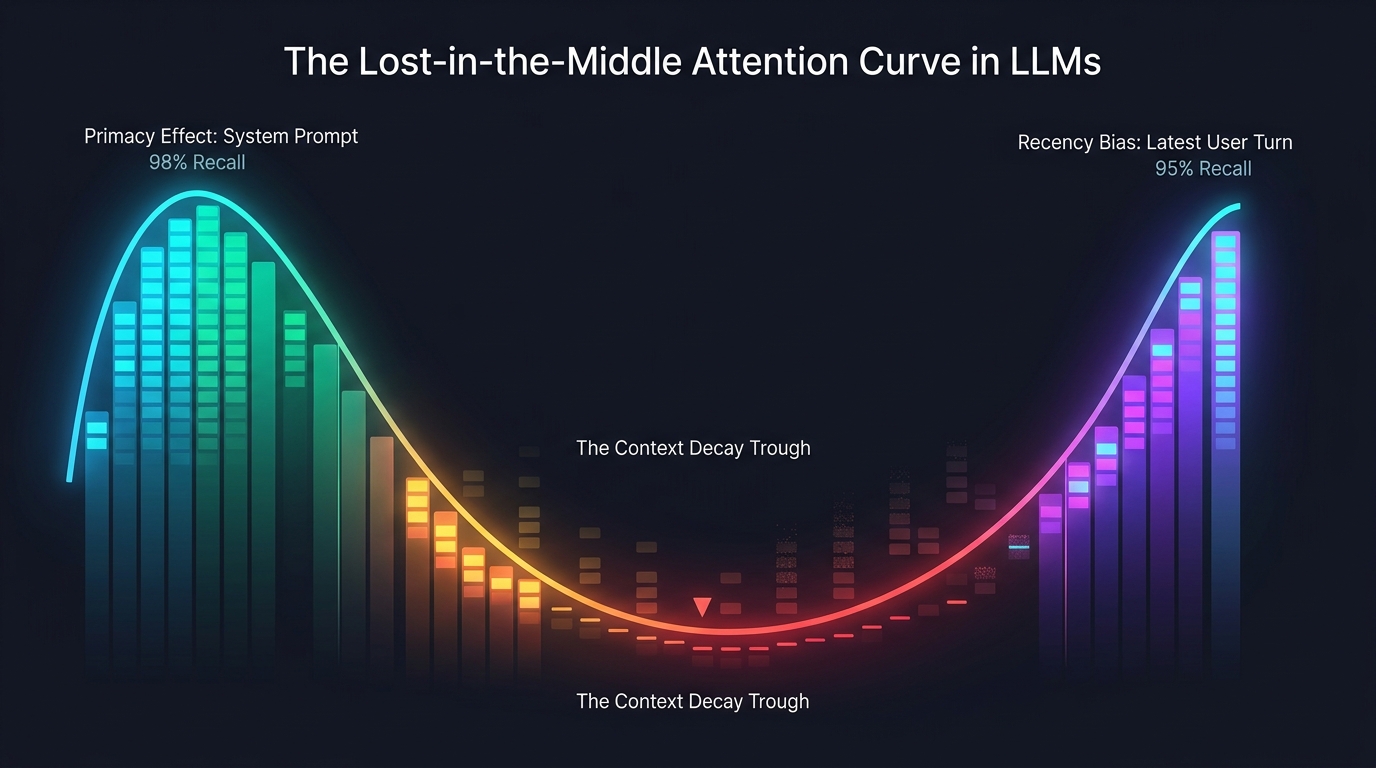
B. Lost in the Middle: The U-Shaped Attention Curve
Liu et al.’s influential study, Lost in the Middle: How Language Models Use Long Contexts, demonstrated that models perform best when relevant information appears at the beginning or end of the input and substantially worse when it sits in the middle:
- Primacy Bias (Beginning): Strong attention recall. System prompt instructions and initial task framing dominate.
- The Attention Trough (Middle 60–80%): Weak, unstable attention recall. Constraints, older corrections, and intermediate specifications buried here suffer catastrophic recall drops (up to 40%–60% degradation).
- Recency Bias (End): Strong attention recall. The most recent user prompt, immediate input data, and final anchors command immediate focus.
This does not mean the middle of your context is useless. It means the middle is the worst possible place for non-negotiable operational rules. Put durable constraints at the beginning, and re-anchor the most critical ones immediately before generation.
C. Context Contamination & Token Entropy
Context drift is not only about token count; it is about what enters the transcript. Common contaminants include:
- Failed code attempts: That remain permanently in the context history.
- Apologetic corrections: Such as “Sorry, I misunderstood your requirements!”
- Exploratory drafts: That were rejected or superseded.
- Long tool logs & stack traces: That dilute domain relevance.
- Conversational thrashing: Repeated user frustration that unintentionally makes the error pattern more salient.
A model conditioned on five failed attempts has five examples of the failure mode in its context. Even if you say “ignore the earlier attempts,” the failed material still shapes next-token prediction. The model is trained to continue patterns; a polluted transcript is itself a pattern.
3. Four Subtle Mistakes That Guarantee Instruction Decay
Most prompt engineers and developers inadvertently trigger context drift by making four structural design errors:
Mistake 1: The Negative-Constraint Fallacy
“Do not use jargon” is a weak instruction. “Use plain English: explain any technical term in one short clause on first use” is a resilient, production-grade instruction.
Negative constraints fail because they specify an exclusion without supplying the replacement behavior. The model must infer what to do instead, and under long-context attention pressure that inference collapses.
| Weak Negative Constraint | Stronger Positive Schema (Replacement Action) |
|---|---|
| “Don’t hallucinate.” | “If a fact is not present in the provided sources, write UNKNOWN and list the missing evidence.” |
| “Don’t use jargon.” | “Write at a senior-engineer level. Define any specialized term in parentheses on first use.” |
| “Don’t break the schema.” | “Return only valid JSON matching the provided schema. Before the JSON, verify each required field in thinking_state.” |
| “Don’t mention pricing.” | “Omit pricing. If pricing is relevant, write: 'Pricing requires formal approval from Enterprise Sales.'” |
Mistake 2: The Monolithic Mega-Prompt Anti-Pattern
A 40-rule prompt is not an engineering specification; it is an attention lottery. Models handle instructions dramatically better when rules are grouped by purpose, prioritized, and made testable. A production prompt must cleanly distinguish:
- Identity & Role: Who the model is.
- Hard Constraints: Conditions that make the output completely invalid.
- Workflow: The step-by-step sequence of operations.
- Output Contract: Exact structure, fields, and schema.
- Escalation Rules: What to do when information is missing or conflicting.
- Canonical Examples: Few-shot demonstrations of expected output.
A useful heuristic: If you cannot write a deterministic unit test that would detect violation of a rule, it is too vague to survive a multi-turn session.
Mistake 3: Chat Thrashing (Compounding Error Loops)
Chat thrashing occurs when you try to repair a drifting conversation by piling on more corrections in the same thread:
- Turn 8: “No, use PostgreSQL.”
- Turn 12: “I said PostgreSQL, not MySQL.”
- Turn 16: “Why are you still using MySQL? Use PostgreSQL!”
By Turn 20, the context contains several competing versions of the instruction, plus multiple failed outputs. The newest correction has recency advantage, but the accumulated noise increases ambiguity. The fix is never another correction. It is compaction: preserve the decision, discard the failed narrative, and restart from a clean state.
Mistake 4: Relying on Ephemeral Chat History as State Storage
Chat history is an append-only, unstructured, lossy buffer full of duplicates and pleasantries. It is optimized for conversational continuity, not operational truth. If your project depends on decisions like “we use PostgreSQL 16,” “the API base URL is X,” or “all timestamps are ISO-8601,” those facts need a durable, inspectable source of truth.
4. Five Production-Grade Fixes (With Runnable Code Templates)
To eliminate instruction drift, enterprise engineering teams replace polite conversational reminders with deterministic architectural patterns.
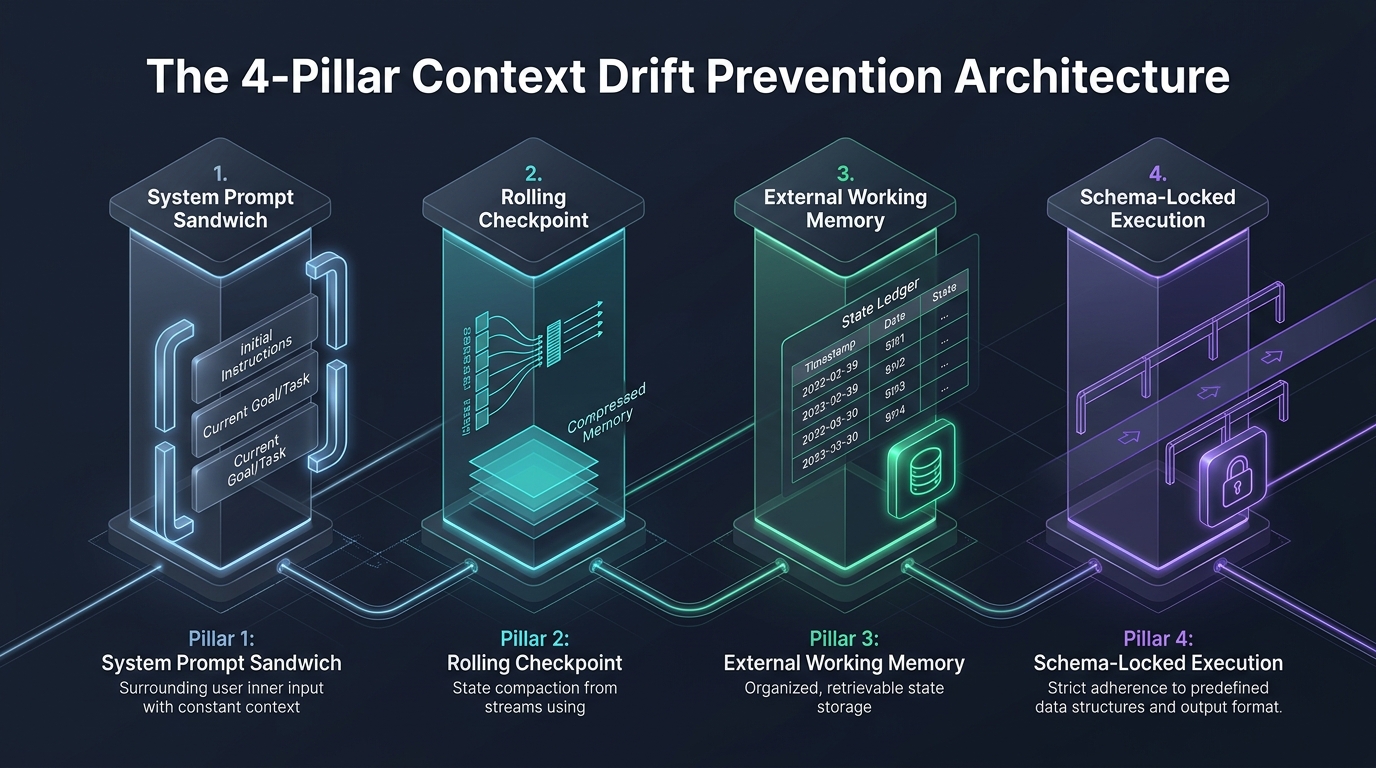
Fix 1: The System-Prompt Sandwich (Primacy + Recency Anchoring)
Place durable constraints at the top of the system prompt, then re-inject a compact constraint anchor immediately before the final user request. This simultaneously leverages both primacy and recency bias:
# SYSTEM: Senior Full-Stack Engineering Assistant
You are a senior full-stack engineer assisting with production code changes.

## Non-negotiable constraints
1. Use TypeScript strict mode.
2. Use PostgreSQL 16; never propose MySQL, MongoDB, or SQLite unless explicitly requested.
3. Do not invent APIs, environment variables, package names, or file paths.
4. If required context is missing, ask exactly one focused clarifying question.
5. Return code only after listing assumptions in a section titled `ASSUMPTIONS`.

## Workflow
1. Restate the task in one sentence.
2. Identify affected files and dependencies.
3. Propose the smallest safe change.
4. Provide complete, runnable code.
5. List validation steps.

---
... [10 Turns of conversation and intermediate work] ...
---

# USER REQUEST
Add retry logic with exponential backoff to the payment webhook handler.

# CONSTRAINT ANCHOR
Before responding, enforce:
- TypeScript strict mode enabled
- PostgreSQL 16 dialect only
- No invented APIs or unverified third-party packages
- Must begin with `ASSUMPTIONS` before emitting codeFix 2: Context Compaction & The 10-Turn State Checkpoint
Every 8–10 turns—or immediately after a major architectural decision, bug fix, or scope shift—run a distillation pass. Convert the entire conversation into a dense state artifact, then continue in a clean thread using only that artifact:
# CONTEXT DISTILLATION META-PROMPT
You are a context-compaction engine. Your job is to preserve operational truth, not conversational history.
Compress the conversation above into the exact Markdown structure below.
Do not add information that is not supported by the conversation.
Resolve contradictions using the most recent explicit user decision.
Discard failed attempts, apologies, redundant explanations, and abandoned ideas.
Output only the artifact.

# PROJECT STATE ARTIFACT
## Objective
- Primary goal:
- Success criteria:
- Explicit out of scope:

## Current decisions
- Decision:
- Rationale:
- Date/turn:
- Status: ACTIVE | SUPERSEDED

## Technical constraints
- Language/runtime:
- Frameworks and versions:
- Data store:
- APIs and integrations:
- Security/compliance constraints:
- Performance constraints:

## Approved artifacts
- Files/components:
- Interfaces:
- Data models:
- Commands:

## Discarded approaches
- Approach:
- Why rejected:

## Open questions
- Question:
- Blocking decision:
- Required owner/input:

## Next actions
1.
2.
3.

## Constraint anchor
Before any future response, enforce:
- [Rule 1]
- [Rule 2]
Then initialize your clean session with this lightweight bootloader:
# OPERATING CONTEXT
Below is the authoritative project state. Treat it as the source of truth.
Do not infer requirements that are absent from this artifact.

[PASTE STATE ARTIFACT HERE]

# CURRENT TASK
[PASTE NEXT IMMEDIATE TASK]

# RESPONSE CONTRACT
1. Begin with `ASSUMPTIONS`.
2. Identify any conflict between the task and the state artifact.
3. Provide the smallest safe implementation.
4. End with `VALIDATION STEPS`.
Fix 3: External Working Memory (Persistent File Anchors)
For serious software projects, use deterministic files rather than hoping chat memory holds. Modern agentic tools (such as Antigravity, Cursor, and Windsurf) rely on files like AGENTS.md, CLAUDE.md, or STATE.md loaded at the start of each turn:
# PROJECT STATE
## Product
Build a multi-tenant invoicing API for small businesses.

## Stack
- TypeScript 5.6, Node.js 22
- Fastify web framework
- PostgreSQL 16 with Prisma ORM
- Redis for BullMQ job queues
- GitHub Actions for CI

## Hard rules
- All money values must be stored as integer minor units (cents).
- Every database query MUST filter by `tenant_id`.
- Absolutely no direct SQL string interpolation.
- Every public endpoint requires authentication except `/healthz`.
- Use conventional commits format.

## Active decisions
- Use idempotency keys for all payment mutation endpoints.
- Store invoices as immutable records; corrections generate a revision record.
- Store UTC timestamps in DB and return ISO-8601 in API responses.

## Definition of Done
- Types compile cleanly under strict mode.
- Unit and integration tests pass (100% route coverage).
- No secrets or tenant data leaked into logs.
Fix 4: Schema-Locked Execution (Self-Validating Guardrails)
For high-stakes generation, force the model to validate its own compliance before outputting user-facing code or data. You can implement this via a two-stage XML wrapper or an OpenAI-style structured response_format:
# RESPONSE CONTRACT
Return exactly two XML blocks in this order:
1. <thinking_state>
2. <final_output>
Do not place any text outside these blocks.

<thinking_state>
{
  "task_understood": string,
  "hard_constraints": string[],
  "constraints_verified": {
    "uses_approved_stack": boolean,
    "no_invented_apis": boolean,
    "includes_required_files": boolean,
    "respects_security_rules": boolean,
    "output_matches_requested_format": boolean
  },
  "missing_information": string[],
  "assumptions": string[],
  "risk_notes": string[]
}
</thinking_state>

<final_output>
{
  "summary": string,
  "files": [
    {
      "path": string,
      "action": "create" | "update" | "delete",
      "contents": string
    }
  ],
  "validation_steps": string[]
}
</final_output>

## Validation rules
- If any `constraints_verified` value is false, set `final_output` to an error object explaining the failure.
- Do not invent file paths, packages, or API endpoints.{
"response_format": {
"type": "json_schema",
"json_schema": {
"name": "strict_code_delivery",
"strict": true,
"schema": {
"type": "object",
"required": ["thinking_state", "final_output"],
"properties": {
"thinking_state": {
"type": "object",
"required": ["constraints_verified", "assumptions"],
"properties": {
"constraints_verified": {
"type": "object",
"required": ["uses_approved_stack", "no_invented_apis", "schema_valid"],
"properties": {
"uses_approved_stack": { "type": "boolean" },
"no_invented_apis": { "type": "boolean" },
"schema_valid": { "type": "boolean" }
},
"additionalProperties": false
},
"assumptions": { "type": "array", "items": { "type": "string" } }
},
"additionalProperties": false
},
"final_output": {
"type": "object",
"required": ["answer", "validation_steps"],
"properties": {
"answer": { "type": "string" },
"validation_steps": { "type": "array", "items": { "type": "string" } }
},
"additionalProperties": false
}
},
"additionalProperties": false
}
}
}
}Fix 5: The Hard-Reset Protocol (When to Kill the Thread)
Do not salvage every drifting conversation. Reset the thread when any of the following triggers occur:
- The same instruction has been corrected more than twice.
- The model repeatedly reintroduces an already-rejected approach.
- The transcript contains multiple contradictory versions of the requirements.
- The task has changed materially since the initial prompt.
- The context contains multi-megabyte stack traces or failed exploratory drafts.
- The cost of another correction exceeds the cost of restarting with a compacted state artifact.
# HARD RESET CHECKLIST
Continue the active thread ONLY if all 5 conditions hold true:
1. The current task is materially unchanged from the original scope.
2. The latest user instruction is unambiguous.
3. The transcript contains fewer than 2 unresolved corrections.
4. Prior failure outputs are not influencing current code generation.
5. A compact state artifact can be produced without losing required context.

OTHERWISE:
1. Run the Context Distillation Meta-Prompt.
2. Save the resulting markdown state artifact.
3. Kill the current session immediately.
4. Load only the state artifact and the next task into a fresh session.
A reset is not failure. It is garbage collection for conversational context.
5. Context Retention Strategy Comparison Matrix
No single technique solves all context problems. The highest-performing workflows combine a concise system prompt, an external source of truth, periodic compaction, and structural validation:
| Strategy | Implementation Effort | Token Overhead | Retention Reliability | Best Use Case |
|---|---|---|---|---|
| Naive Long Chat | Zero (Default) | Low initially, massive over time | Poor (Degrades with length) | Quick questions, brainstorming, disposable drafts |
| System-Prompt Sandwich | Low (2-line anchor) | Minimal (+30–50 tokens) | Good for short-to-medium sessions | Coding tasks, writing with fixed style, analysis |
| Rolling State Checkpoint | Medium (1 meta-prompt) | Low after compaction | High when performed on schedule | Multi-turn engineering, research, specifications |
| External Memory File (AGENTS.md) | Medium (Setup once) | Static (Re-injected) | High and fully auditable | Codebases, team workflows, recurring agent tasks |
| RAG / Retrieval Scratchpad | High (Vector DB / AST) | Variable (Retrieval adds tokens) | High for facts; lower for rules | Large document sets, knowledge bases, support agents |
| Schema-Locked Execution | Medium (Schema wrapper) | Slight (+80–120 tokens) | High for format & constraint checks | Production APIs, code generation, data extraction |
| Hard Reset + State Artifact | Low once templated | Lowest (Wipes token history) | Very High (100% reset) | Any session showing repeated drift or contradiction |
6. Pre-Flight Context Audit Checklist
Before starting a critical multi-turn session, run through this 6-point pre-flight audit:
- [ ] Can you state the objective in one sentence? If not, the model will optimize for an ambiguous moving target.
- [ ] Are hard constraints separated from preferences? Mark rules that make output invalid. Never bury them among stylistic suggestions.
- [ ] Are negative constraints paired with replacement behavior? Replace “don’t do X” with “when X is relevant, do Y.”
- [ ] Is the authoritative state externalized? Put durable decisions in a project file, issue tracker, or state artifact—not solely in conversational history.
- [ ] Is there a defined output contract? Specify exact format, fields, tone, word boundaries, citation rules, and failure behavior.
- [ ] Do you have a defined reset trigger? Decide in advance when you will compact or restart the thread (e.g. 10 turns or 2 failed corrections).
🛠️ Interactive Tools to Protect Your Context
Stop burning API credits on instruction drift. Use PromptStaging's zero-data-collection, client-side tools to test and build resilient prompts:
7. Frequently Asked Questions
Why does ChatGPT ignore negative constraints like 'do not use jargon'?
Because a prohibition does not fully specify the desired behavior. The model may recognize the constraint but fail to prioritize it among competing instructions, especially after the context becomes long or noisy. Convert it into a positive rule: “Use plain English and define specialized terms in parentheses on first use.”
Does Claude 3.7 or Gemini 2.5 have better long-context instruction retention?
Model families differ, but no current model makes context length equivalent to perfect instruction retention. Larger windows improve what can physically fit into the prompt; they do not remove position effects, attention competition, contamination from failed turns, or ambiguity across many rules. Evaluate your actual prompts and workload rather than relying on vendor context-window claims.
How often should I start a new chat session to prevent instruction drift?
For demanding technical work, compact or restart every 8 to 10 turns, or immediately after a major scope change or repeated correction. The exact number depends on task complexity and transcript size, but the trigger should be state pollution—not merely token count.
What is the difference between Needle-In-A-Haystack retrieval and instruction following?
Needle-In-A-Haystack (NIAH) tests whether a model can locate a specific fact hidden in a long context. Instruction following tests whether it can consistently apply constraints, priorities, formats, and exclusions while generating. A model can retrieve a rule yet still fail to follow it under competing demands; research on long contexts shows that information placement and context length materially affect performance.