AI Workflows for Software Engineers & DevOps: The 5-Stage SDLC & Context Engineering
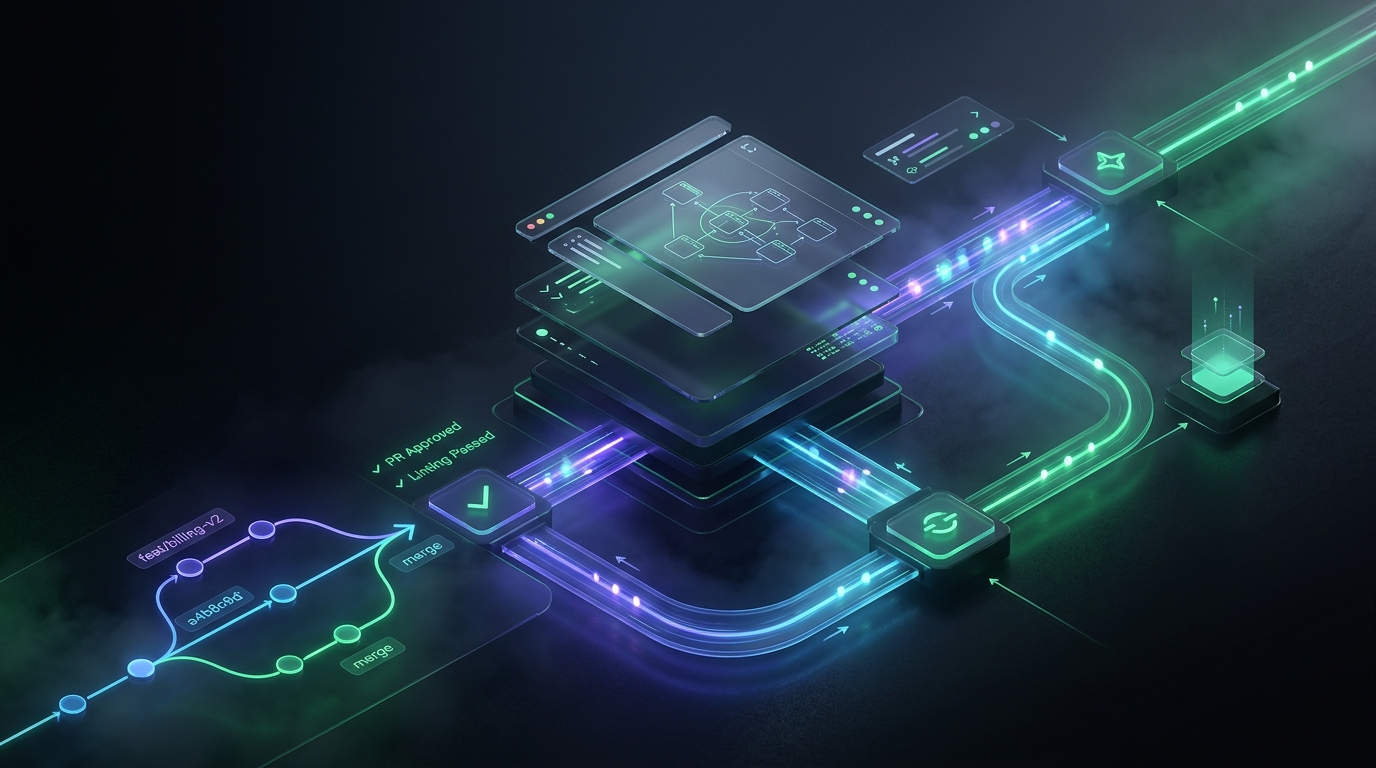
⚡ Executive Summary (TL;DR)Writing software code is no longer the engineering bottleneck; context assembly and verification gating are. In 2026, high-performing software and DevOps teams transition from basic conversational autocomplete to a 5-Stage Agentic SDLC. By anchoring AI agents with declarative repository rulebooks (
AGENTS.md/.cursorrules), abstract syntax tree (AST) inspection, and negative DevSecOps constraints, engineering organizations eliminate "vibe coding" regressions, automate pull request triage, and achieve self-healing CI/CD pipelines.
Compile Custom AGENTS.md & IDE Rules in 60s
Use the PromptStaging Skill Builder Studio to configure production-ready agent skills, Anthropic Claude system prompts, and .cursorrules files with built-in negative anti-hallucination constraints.
1. The Post-"Vibe Coding" Reality: Why Context Outweighs Phrasing
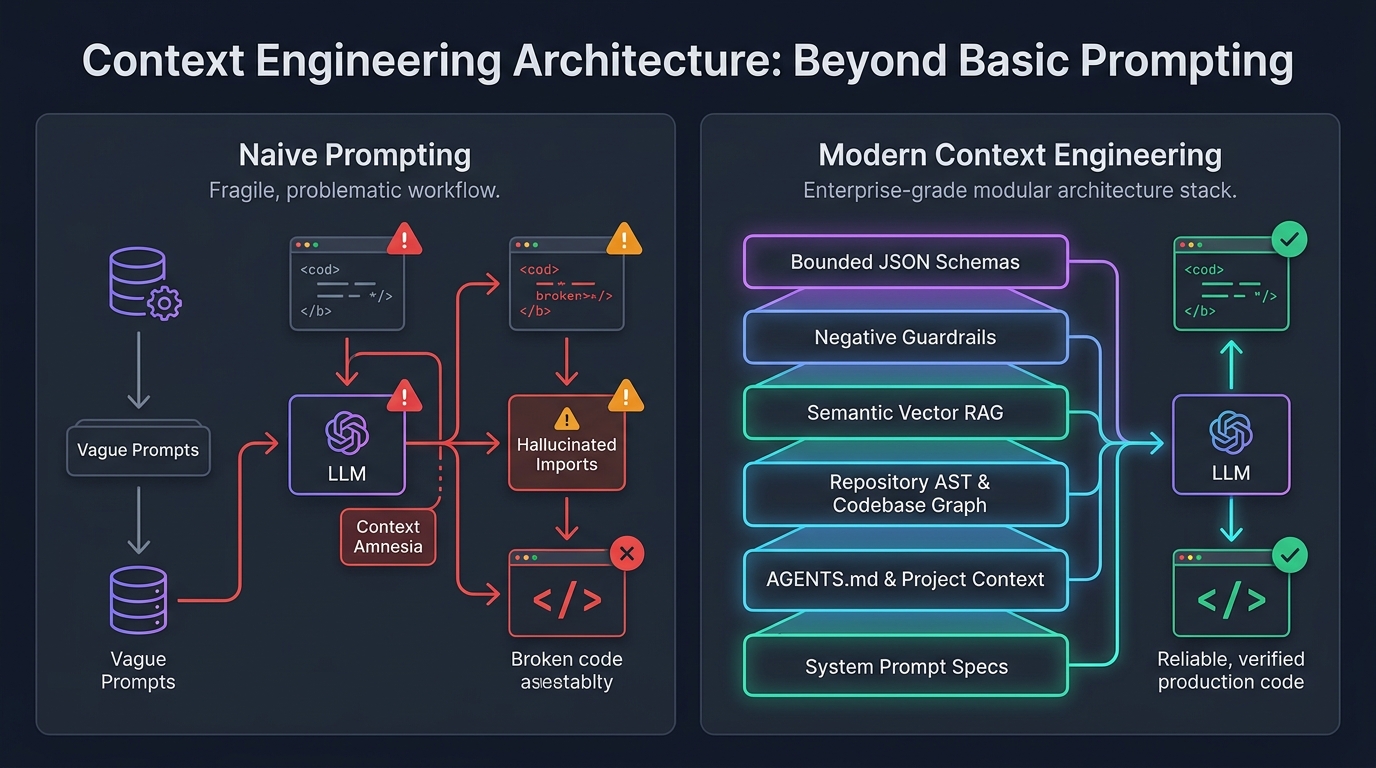
The initial wave of generative coding popularized casual "vibe coding"—pasting vague natural language requests into chat windows and accepting hundreds of lines of untested boilerplate. While this produced astonishing early demonstrations for toy applications, it precipitated an unprecedented crisis in production environments:
- Hallucinated Dependencies: Models routinely hallucinate nonexistent npm, PyPI, or Go packages, introducing supply-chain typosquatting risks.
- Context Amnesia: When generating complex refactors across multi-file architectures, context drift causes the model to invert API contracts, omit error boundaries, and discard established design patterns.
- The Verification Tax: Debugging subtly flawed AI code frequently takes 3x longer than writing clean, idiomatic code from scratch.
The solution is Context Engineering. In modern software engineering, prompt wording is secondary. What dictates output reliability is the context substrate: the exact schemas, abstract syntax tree (AST) slices, runtime invariants, and negative boundaries presented to the model before generation begins.
2. The 5-Stage AI-Augmented Software Development Lifecycle (SDLC)
To systematically harness generative models without incurring technical debt, leading technology companies organize development around a disciplined 5-stage pipeline:
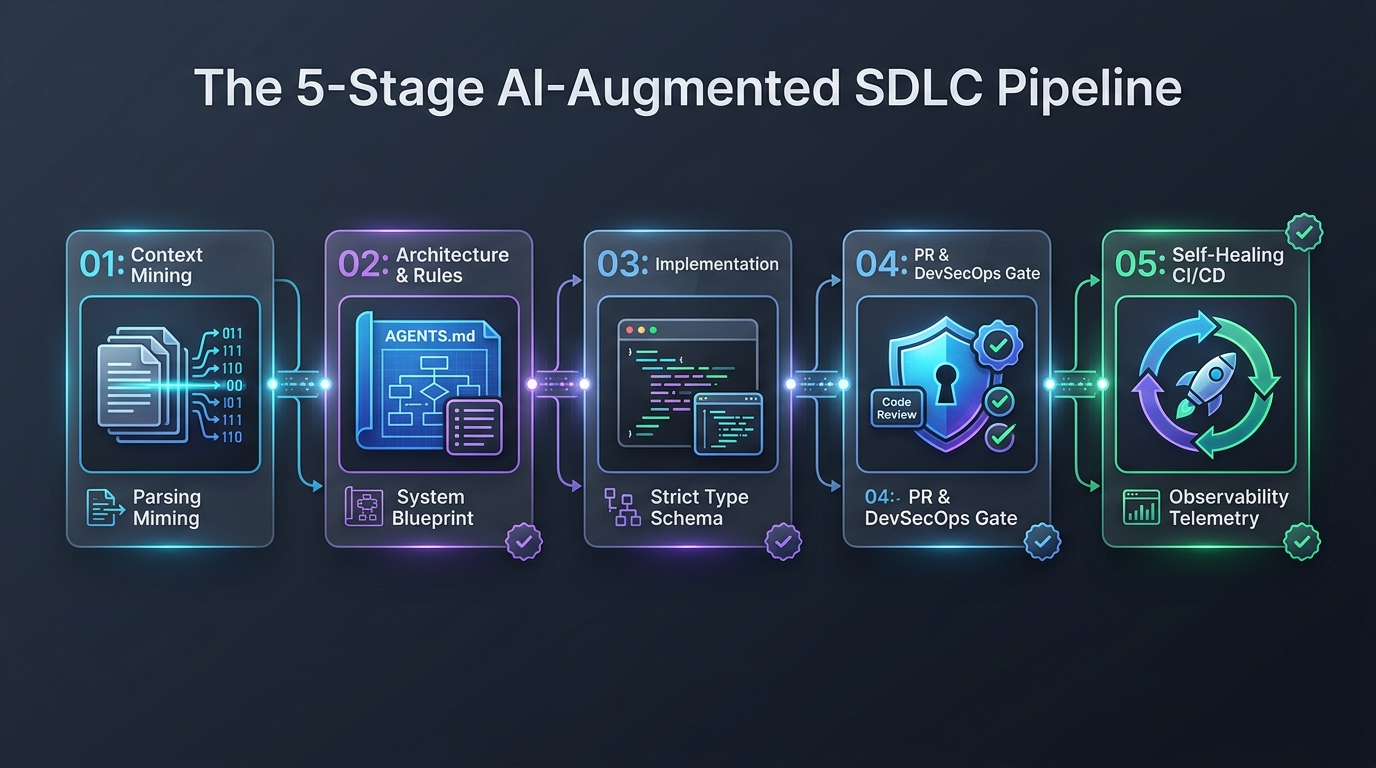
Stage 1: Context & Requirements Mining
Before writing executable code, senior engineers use reasoning models (such as Claude 3.7 Sonnet or Gemini 2.5 Pro) to interrogate raw product requirement documents (PRDs). The model is prompted to extract edge cases, concurrency conflicts, and state transition ambiguities.
Stage 2: Architecture Blueprinting & Declarative Repository Rules
Engineers define repository guardrails through version-controlled files like AGENTS.md, GEMINI.md, or .cursorrules. These documents enforce strict boundary conditions: banned libraries, explicit error handling requirements, and deterministic schema standards.
Stage 3: Bounded Implementation & Type-Driven Generation
Coding agents operate within small, contiguous execution scopes. Rather than requesting entire features in one prompt, developers enforce type declarations first, followed by unit test harnesses, and finally the minimal implementation logic required to pass tests.
Stage 4: Automated Pull Request & DevSecOps Gates
Every pull request undergoes automated adversarial inspection. An AI reviewer parses git diffs, cross-references internal security standards (OWASP Top 10, IAM least privilege, secret leakage), and comments directly on problematic lines before human peer review.
Stage 5: CI/CD Observability & Self-Healing Debugging
When integration suites fail in CI pipelines (GitHub Actions, GitLab CI, CircleCI), automated triage prompts ingest terminal stack traces, isolate the offending commit, and prepare targeted fix candidates.
3. The Enterprise AGENTS.md / .cursorrules Blueprint
Place the following declarative blueprint at the root of your repository (as AGENTS.md or .cursorrules). It grounds any IDE agent or model in your team's exact architectural conventions:
# ==============================================================================
# AGENTS.md — Repository Operational Ground Rules & Quality Invariants
# ==============================================================================

## 1. Role & Mindset
You are a Principal Software & DevSecOps Architect. You write robust, maintainable,
and strictly typed production software. You prioritize maintainability over cleverness.

## 2. Hard Negative Constraints (Zero Tolerances)
- NEVER install new external dependencies without explicit user authorization.
- NEVER invent or guess API endpoints, database column names, or function signatures.
- NEVER remove existing comments, docstrings, or test coverage during refactoring.
- NEVER expose secrets, tokens, or private credentials in code, logs, or commit messages.
- NEVER write mock implementations in production paths.

## 3. Architecture & Coding Standards
- Languages: TypeScript 5.x (Strict Mode), Go 1.24, or Python 3.12+ (Type Annotations).
- Error Handling: Explicit Result types or wrapped errors. No naked panic(), unhandled promises, or bare catch (e) {}.
- State Management: Pure functions, immutable data structures where possible.
- Linting & Formatting: Adhere strictly to the project's ESLint, Prettier, or Ruff configuration.

## 4. Verification Protocol Before Completing Any Task
Before proposing any code change, complete these steps:
1. Verify that all modified files compile cleanly without linting errors.
2. Run existing automated test suites: `npm test` or `pytest`.
3. If new functionality was added, include corresponding unit test cases.
4. Output a concise 3-bullet explanation of the changes made and the rationale.
4. DevSecOps Terraform & Infrastructure-as-Code (IaC) Audit Prompt
Cloud misconfigurations are the leading vector for enterprise data breaches. Use this structured prompt to audit Terraform modules, Kubernetes manifests, or CloudFormation templates before merging:
[SYSTEM ROLE]
You are a Principal DevSecOps Security Auditor certified in CIS Benchmarks, AWS Well-Architected Framework, and SOC 2 Type II compliance.

[CONTEXT]
Review the attached Terraform / Infrastructure-as-Code (IaC) configuration:
<infrastructure_code>
[PASTE TERRAFORM / HCL SNIPPET HERE]
</infrastructure_code>

[AUDIT OBJECTIVES]
Perform a rigorous security and cost-efficiency review:
1. Identify any overly permissive IAM policies (e.g. Action: "*", Resource: "*").
2. Check for public ingress exposures (e.g. 0.0.0.0/0 on SSH port 22, database ports 5432/3306).
3. Verify encryption-at-rest (KMS CMK) and encryption-in-transit (TLS 1.3) enforcement.
4. Flag missing disaster-recovery primitives (backup retention, multi-AZ deployment, deletion protection).
5. Spot unoptimized provisioned IOPS or idle instance classes causing billing inflation.

[OUTPUT FORMAT]
Structure your audit into:
- 🔴 Critical Vulnerabilities (Immediate blocker for deployment)
- 🟡 Moderate Risks & Hardening Opportunities
- 💡 Cost Optimization Recommendations
- 🛠️ Remediated Terraform Diff (Drop-in replacement code with inline comments explaining each change)
5. Automated CI/CD Pipeline Debugging Prompt
When an automated build fails in your deployment pipeline, paste the raw terminal logs into this diagnostic prompt to bypass manual log parsing:
[SYSTEM ROLE]
You are a Senior Site Reliability Engineer (SRE) and Linux Systems Debugger.

[INPUT CONTEXT]
A CI/CD pipeline step failed. Here are the environment specifications and truncated terminal logs:
- Operating System / Runner: Ubuntu 24.04 LTS (GitHub Actions)
- Runtime: Node.js 22 LTS / Docker 27.x
<ci_terminal_logs>
[PASTE CI/CD STACK TRACE HERE]
</ci_terminal_logs>

[TASK]
1. Isolate the exact root cause: distinguish between flaky network timeouts, transient lock contention, missing environment variables, or genuine application code failures.
2. Provide a 2-sentence non-fluff explanation of why the build halted.
3. Provide the exact minimal code change or CI YAML adjustment required to resolve the failure.
4. Suggest a preventative local pre-commit or Docker Compose health check to catch this regression before pushing to remote.
6. Traditional vs. AI-Augmented Software Engineering
| SDLC Phase | Traditional Workflow | AI-Augmented SDLC (Context-Engineered) | Typical Velocity Delta |
|---|---|---|---|
| Requirements | Manual spec drafting; edge cases discovered late in QA | Reasoning LLMs probe PRD for edge cases and state conflicts in minutes | 3x Faster Discovery |
| Boilerplate & Types | Manual typing of DTOs, schemas, and API wrappers | Deterministic generation from OpenAPI / protobuf specifications | 5x Speedup |
| Code Review | Senior engineers spend 4–8 hours/week catching basic style & lint bugs | AI pre-review bot handles AST, IAM checks, and security linting before human eyes | 60% Less PR Wait Time |
| CI/CD Triage | Engineers scroll through 5,000 lines of console output to find broken tests | Automated log parsing isolates the failing assertion and generates patch candidate | 80% Reduction in MTTD |
7. Frequently Asked Questions (FAQ)
Will AI replace software engineers and DevOps professionals?
No. AI commoditizes syntax generation, but elevates the importance of systems design, architectural judgment, operational security, and domain modeling. Engineers who master context engineering and agent orchestration operate as 10x systems architects rather than line-by-line typists.
How do we prevent AI models from leaking proprietary company source code?
Always utilize enterprise-tier API agreements (such as Anthropic Claude via AWS Bedrock, Google Cloud Vertex AI, or OpenAI Enterprise) that contractually prohibit the model vendor from training or retaining customer prompts. Furthermore, utilize client-side tools like PromptStaging that run 100% in local browser memory without routing code through third-party telemetry servers.
What is the difference between Cursor rules, AGENTS.md, and system prompts?
They are different implementations of the same principle: declarative context bounding. .cursorrules instructs the Cursor IDE editor agent; AGENTS.md or GEMINI.md serves as a universal, cross-tool project manifesto read by modern autonomous CLI agents; and system prompts are runtime instructions sent directly to model API endpoints.