AI for Accountants: Automating Spreadsheets, Invoices & Reconciliation

⚡ Quick Answer (TL;DR)AI accounting workflows allow bookkeepers and CPAs to automate forensic discrepancy checks, parse messy bank feeds into standard charts of accounts, and draft audit-ready tax deduction memos in minutes. By utilizing zero-retention prompt templates and mathematical sanity checks, accounting teams save an average of 6.2 hours per week without compromising client confidentiality.
What Is an AI Accounting Workflow?
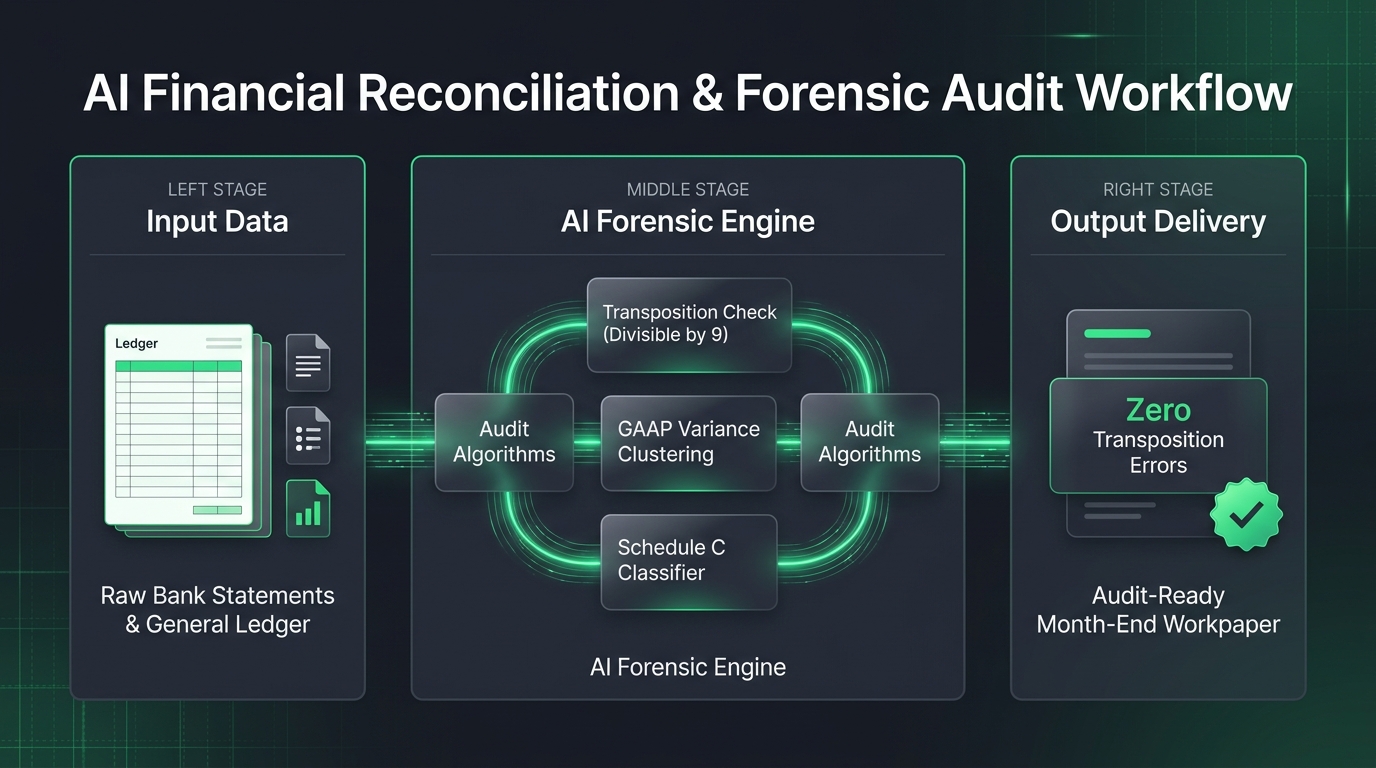
An AI accounting workflow is a methodical, rule-governed process that applies large language models to tabular financial datasets, general ledgers, and transaction feeds to automate reconciliation, error diagnosis, and categorization. Unlike generic chatbot prompting, accounting workflows rely on strict GAAP guidelines, verification constraints, and anonymized inputs to maintain rigorous compliance standards.
Manual Bookkeeping vs. AI-Augmented Accounting
| Accounting Task | Traditional Manual Method | AI-Augmented Workflow | Risk Mitigation |
|---|---|---|---|
| Month-End Reconciliation | Line-by-line manual tick-and-tie in Excel | Automated discrepancy clustering & transposition test | Eliminates human transposition blindness |
| Complex Expense Classification | Manual research through IRS publications | Prompt query cross-referencing Schedule C codes | Consistent audit-trail documentation |
| Formula Architecture | Trial-and-error debugging of nested formulas | Instant plain-English LAMBDA / XLOOKUP generation | Syntax error verification |
| Management Reporting | Writing variance memos from scratch (3 hours) | Auto-drafting executive variance narratives in 10 mins | Highlighting statistical outliers automatically |
The Modern Accounting Shift: From Data Entry to Strategic Advisory
The accounting profession is experiencing its most profound transformation since the transition from paper general ledgers to computerized spreadsheets in the 1980s. Historically, junior accountants and bookkeepers spent up to 60% of their billable hours performing manual data entry: matching bank statement lines against ERP transactions, tracking down unclassified credit card receipts, and chasing missing vendor invoices.
In 2026, firms that continue to bill clients purely for manual clerical reconciliation face intense margin compression. Top-tier CPA firms and corporate controllers are deploying structured AI workflows to automate routine ledger hygiene, allowing their teams to reallocate recovered hours into forward-looking cash flow modeling, fractional CFO advisory, and proactive tax mitigation.
However, financial accounting admits zero tolerance for hallucinations. A single invented deduction or incorrect decimal point can trigger costly IRS audits, penalties, or restated earnings. Implementing dependable AI workflows requires rigid mathematical boundaries, deterministic prompts, and strict verification checkpoints.
Step 1: Forensic Bank & General Ledger Reconciliation Engine
When an unadjusted trial balance fails to reconcile with the monthly bank statement—leaving an unexplained variance of $1,440.00 across hundreds of line items—manual row-by-row cross-checking can consume an entire afternoon.
Senior auditors use mathematical diagnostic principles to isolate root causes in seconds. The prompt below applies transposition testing (checking if the variance is divisible by 9 to detect inverted adjacent digits), timing lag analysis (deposits in transit vs. outstanding checks), and merchant fee holdback detection:
Act as a forensic CPA and audit senior reviewing a month-end bank reconciliation. I have an unresolved variance between our General Ledger cash account and the monthly bank statement.

Variance Data:
- Ledger Ending Balance: $[Insert Amount]
- Bank Statement Ending Balance: $[Insert Amount]
- Net Discrepancy: $[Insert Amount] (Ledger is [Over / Under] Bank)
- Target Account & ERP: [e.g. Operating Checking, QuickBooks Online / NetSuite]
- Reporting Period: [e.g. September 1 – September 30]

Execute the following diagnostic audit procedures:
1. Transposition & Slide Test:
   - Calculate whether the net discrepancy is evenly divisible by 9.
   - If divisible by 9, output the quotient and list 5 most likely transposed adjacent digit pairs (e.g. entering $8,100 instead of $1,800, or $54 instead of $45) that yield this exact mismatch.
   - Test for a single-column slide error (e.g. dividing or multiplying by 10, 100, or 1000).
2. Timing & Cutoff Anomaly Analysis:
   - Identify whether the variance matches recurring payroll tax liabilities, monthly SaaS subscriptions, or credit card merchant processing holdbacks (e.g. Stripe 2.9% + 30¢ deductions).
   - Evaluate deposits in transit recorded on the final 2 business days of the month.
3. Diagnostic Investigation Checklist:
   - Provide a step-by-step checklist of specific journal entries, voided checks, and unrecorded wire transfers to inspect.
4. Output Schema:
   - Provide an audit-ready Month-End Workpaper Memo formatted with: Executive Summary, Root Cause Probability Ranking (High/Med/Low), Corrective Journal Entry (Debit Account, Credit Account, dollar amounts), and Permanent Audit Trail Reference.
Step 2: IRS Schedule C & Form 1120-S Tax Deductibility Classifier
Categorizing hundreds of ambiguous credit card charges at tax year-end—distinguishing meals under IRC Section 274 from entertainment, client gifts from marketing, and capital asset improvements from routine repairs—is notoriously time-consuming.
This workflow ingests raw bank transaction descriptions and classifies each into the proper tax line item, calculating the exact allowable deduction percentage and generating substantiation flags:
Act as a Certified Public Accountant (CPA) and corporate tax specialist. I am categorizing business expenses for an entity filing [IRS Schedule C / Form 1120-S / Form 1065].

Review the attached batch of raw transaction entries:
[Paste raw CSV rows: Date, Vendor Name, Amount, Transaction Description]

For each transaction line, output a structured markdown table with the following 6 columns:
1. Date & Vendor: Standardized clean merchant name.
2. Dollar Amount: Formatted currency.
3. Tax Return Category: Exact tax return line item (e.g. Line 24b Deductible Meals, Line 18 Office Expense, Line 9 Car & Truck, Line 27 Other Expenses).
4. Allowable Deductible %: Explicit percentage allowable under current tax regulations (e.g. 50% for business meals with clients, 100% for company-wide employee holiday parties, 0% for entertainment/sporting event tickets under TCJA).
5. De Minimis Safe Harbor: Flag if amount is under $2,500 and qualifies for immediate expensing under Treas. Reg. § 1.263(a)-1(f) rather than balance-sheet capitalization.
6. Audit Substantiation Requirement: Specify required documentation needed in the workpapers (e.g. itemized receipt + business purpose + names of attendees for business meals over $75).

Negative Constraints:
- Never classify club dues, entertainment tickets, or political contributions as deductible.
- If a vendor description is ambiguous (e.g. Amazon, Target, PayPal), mark category as "UNCERTAIN - REVIEW RECEIPT" and request specific business justification.
Step 3: 13-Week Rolling Cash Flow Forecasting Engine
Cash flow insolvency is the primary reason profitable small and mid-sized businesses fail. While traditional balance sheets show trailing financial health, business owners require forward-looking visibility into their exact cash position week-by-week.
This prompt takes trailing Accounts Receivable (AR) aging reports, recurring Accounts Payable (AP) commitments, and planned payroll runs to model an agile 13-week rolling liquidity projection:
Act as a fractional CFO and treasury analyst. I will provide current cash balance, AR aging summary, AP aging summary, and recurring operating expense commitments.

Financial Baseline:
- Beginning Cash Balance (Week 1): $[Insert Amount]
- Total Current AR: $[Insert Amount] (Breakdown: 0-30 days $[X], 31-60 days $[Y], 61+ days $[Z])
- Total Current AP: $[Insert Amount] (Due within 15 days $[A], Due within 30 days $[B])
- Bi-Weekly Payroll: $[Insert Amount] (Disbursed on Weeks 2, 4, 6, 8, 10, 12)
- Monthly Fixed Rent & Debt Service: $[Insert Amount] (Due Week 1, Week 5, Week 9)
- Historical AR Collection Lag: Typically 85% collected in 30 days, 10% in 60 days, 5% write-off/delay.

Generate a 13-Week Rolling Cash Flow Forecast Model:
1. Model 3 Scenarios for Net Cash Ending Balance:
   - Expected (Base Case): Normal collection velocity and scheduled disbursements.
   - Conservative (Downside): AR collections delayed by 2 weeks; vendor AP paid on net-30 terms.
   - Optimistic: 95% collection rate, early payment discount incentives utilized.
2. Highlight Liquidity Danger Zones: Explicitly flag any week where ending cash drops below our minimum reserve threshold of $[Insert Minimum Reserve, e.g. $50,000].
3. Cash Preservation Tactics: Provide 3 actionable recommendations if a shortfall is projected (e.g., vendor credit extension, accelerating customer invoicing, drawing on revolving credit line).
Step 4: Advanced Excel & Google Sheets Formula Generator
Modern spreadsheets feature dynamic array formulas that replace hundreds of legacy rows with single-cell functions. However, nesting LAMBDA(), MAP(), XLOOKUP(), and CHOOSEROWS() without syntax errors or circular references can derail an accountant's workflow.
Prompting AI with your exact worksheet layout and desired mathematical outcome generates pristine, self-documenting formulas instantly:
Act as a Microsoft Excel MVP and Google Sheets formula architect. I need a robust, non-volatile formula to perform the following transformation.

Sheet Layout:
- Tab 1 Name: "GL_Transactions" (Columns: A=Date, B=AccountCode, C=Description, D=Debit, E=Credit, F=Department)
- Tab 2 Name: "Department_Summary" (Summary table where Department names are in Column A, starting at row 5)

Objective:
In Tab 2, calculate Net Spend (Sum of Debits minus Sum of Credits) for each department, but ONLY include transactions occurring between [Start Date in cell B1] and [End Date in cell B2], excluding any AccountCode beginning with "9" (intercompany eliminations).

Requirements:
1. Provide the modern Excel dynamic formula using LET(), FILTER(), and SUM() to prevent repetitive calculation overhead.
2. Provide an alternative Google Sheets formula using QUERY() or SUMIFS().
3. Add step-by-step commentary explaining each variable definition in the LET() function.
4. Error handling: Wrap with IFERROR() returning 0.00 if no matching records exist.
Step 5: Month-End Budget-vs-Actual Variance Analysis & Board Memo
Senior leadership does not read raw 500-line budget spreadsheets. They want an executive summary explaining why revenue or operating expenses deviated from forecast, isolating price variances from volume variances.
This prompt converts raw variance tables into a polished, C-suite executive briefing:
Act as a Chief Financial Officer (CFO) and VP of Financial Planning & Analysis (FP&A). I will provide month-end budget vs actual variance figures.

Financial Inputs:
- Revenue: Budget $[X], Actual $[Y] (Variance: $[Z] or [%])
- Gross Margin %: Budget [X]%, Actual [Y]%
- Operating Expenses:
  - R&D: Budget $[X], Actual $[Y]
  - Sales & Marketing: Budget $[X], Actual $[Y]
  - G&A: Budget $[X], Actual $[Y]
- Key Qualitative Drivers: [e.g. Server hosting costs surged 22% due to enterprise customer onboardings; 2 unfilled engineering roles reduced payroll expense]

Generate a 1-Page Executive Board Memo:
1. Executive Takeaway: 3 bullet points summarizing top-line performance, margin trajectory, and EBITDA impact.
2. Revenue Analysis: Is the variance driven by pricing, customer churn, or sales cycle delays?
3. Opex Deep Dive: Isolate timing differences (expenses delayed to next quarter) from permanent overages.
4. Corrective Action Plan: 2 concrete tactical levers management should pull in the upcoming quarter to maintain full-year guidance.
Client Confidentiality & AICPA SOC 2 Compliance Protocols
CPAs and fiduciary advisors are ethically bound by AICPA Rule 301 (Confidential Client Information) and regulatory frameworks like Gramm-Leach-Bliley (GLBA). Before running any client ledger feeds through an AI engine, implement this mandatory sanitization protocol:
- Tokenize Entity Names: Replace "Acme Steel Corp" with "Client Alpha" and vendor names with generic industry tags ("Vendor 101 - Logistics").
- Redact Account Identifiers: Run a regular expression script to scrub all 9-digit SSNs, EINs, ABA routing numbers, and IBAN codes.
- Verify Zero Data Retention (ZDR): When selecting AI subscriptions, confirm your organization holds an enterprise agreement ensuring input prompts are deleted immediately after inference and exempt from model retraining.
Financial AI Tool Stack: Model Capabilities Compared
| Engine / Software | Core Financial Strength | Ideal Use Case | Price Range |
|---|---|---|---|
| Claude 3.7 Sonnet | Flawless adherence to multi-layered GAAP accounting rules, memo drafting | Audit workpapers, policy memos, tax deductibility classification | $20 / user / mo |
| ChatGPT-4o (Data Analysis) | Native Python runtime sandbox for executing math directly on uploaded CSVs | Multi-thousand line reconciliation, automated charting, pivot tables | $20 / user / mo |
| Gemini 2.5 Pro | 1M+ token memory, processes entire year-to-date ledgers and audit binders | Full-year transaction classification, 300-page loan covenant review | $20 / user / mo |
| Vic.ai / Trullion | Specialized autonomous invoice processing & lease accounting automation | Enterprise accounts payable departments with 10,000+ invoices/month | Enterprise custom |
Frequently Asked Questions
Client records must always be scrubbed of Personally Identifiable Information (PII) before model processing. Mask client names, bank routing numbers, and exact employee identifiers, or use business-tier agreements (ChatGPT Enterprise, Claude Team) that provide legally binding SOC 2 zero-data-retention guarantees.
AI models apply mathematical diagnostics to discrepancy amounts—testing for transposition errors (differences divisible by 9), timing lags (deposits in transit, outstanding checks), and merchant fee holdbacks, outputting GAAP-compliant audit workpapers in seconds.
Yes. When prompted with IRS tax code boundaries and Section 274 substantiation rules, AI models accurately categorize raw vendor line items into deductible buckets (e.g., 50% vs 100% meals, ordinary business expenses, capital assets).
Claude 3.7 Sonnet is currently the premier model for audit-trail documentation and strict tabular logic. ChatGPT-4o with Advanced Data Analysis (Python Code Interpreter) is superior for executing mathematical operations directly against multi-megabyte CSV files.
By providing the AI with exact column headers and expected mathematical outputs, models generate error-free nested XLOOKUP, INDEX-MATCH, dynamic array LAMBDAs, and custom VBA/Apps Script macros.
By feeding trailing accounts receivable aging reports and recurring vendor accounts payable schedules into a cash flow prompt, the AI models expected payment velocity, seasonality adjustments, and weekly ending cash balances.
No. AI replaces manual clerical data entry and transaction matching, enabling CPAs and bookkeepers to shift their billing from hourly compliance work to high-margin strategic CFO advisory and forward-looking tax strategy.
System prompts can explicitly define the accounting framework: enforcing U.S. GAAP (such as ASC 606 revenue recognition and ASC 842 lease rules) or IFRS standards (such as IFRS 15 and IFRS 16) with specific citation footnotes in the generated memo.