AI Workflows for Real Estate: Listing Generator, Client Follow-ups & Market Reports

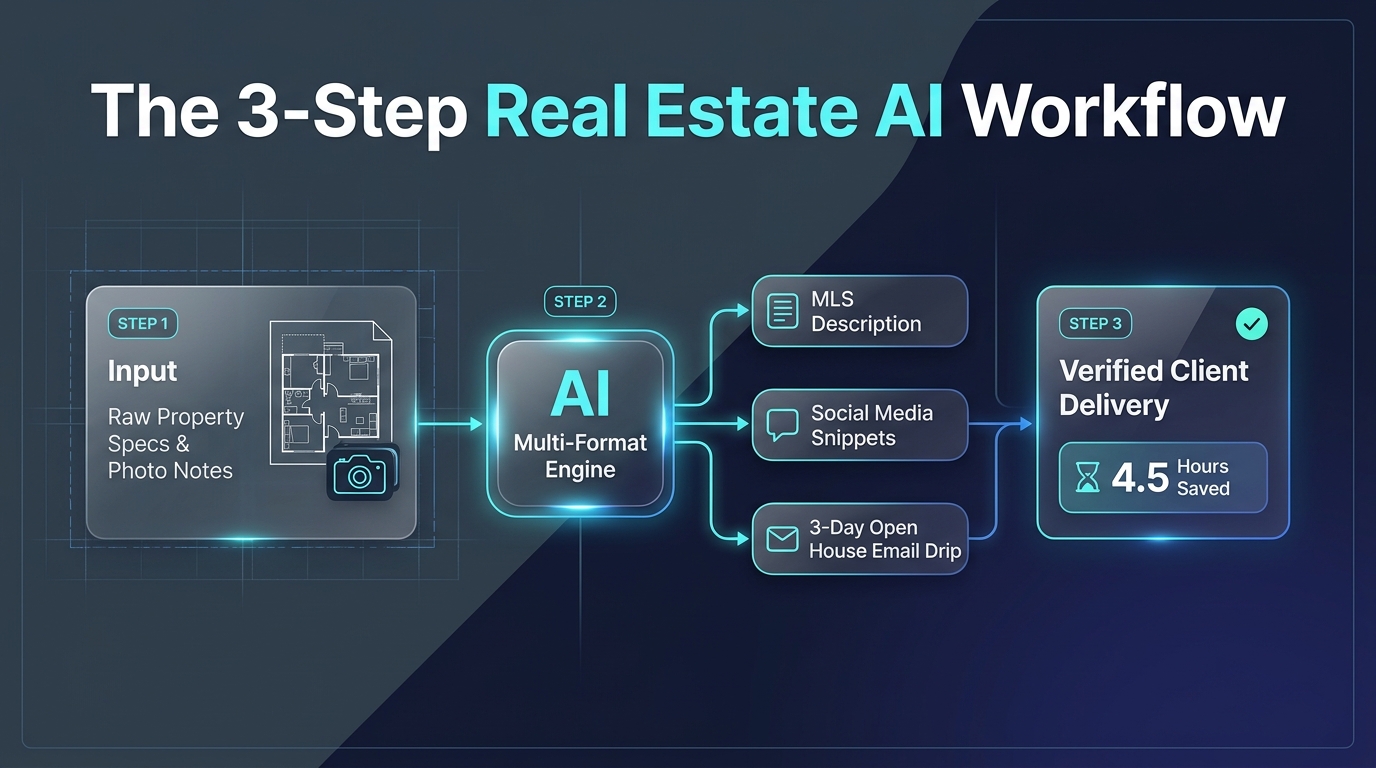
⚡ Quick Answer (TL;DR)Real estate AI workflows replace tedious administrative writing with prompt-driven templates, allowing agents to generate MLS descriptions, open house email drips, and local market reports in under 20 minutes. Implementing structured role prompts saves an average of 4.5 hours per listing while strictly maintaining Fair Housing compliance.
What Is a Real Estate AI Workflow?
A real estate AI workflow is a structured, repeatable prompt architecture that converts raw property data and market statistics into client-ready marketing assets without manual drafting. Instead of starting from a blank page for every new listing or client interaction, agents leverage pre-calibrated system prompts to produce MLS descriptions, automated email follow-up sequences, and neighborhood market updates.
Traditional Property Marketing vs. AI Workflow Architecture
| Workflow Stage | Traditional Manual Method | AI-Assisted Workflow | Time Saved |
|---|---|---|---|
| MLS Description | 60–90 mins staring at photos, drafting copy | 3 mins: Raw bullet input into architectural prompt | ~75 mins |
| Social Captions | 45 mins adapting descriptions for IG/FB/TikTok | 2 mins: Multi-platform variation generator | ~40 mins |
| Open House Drip | 2 hours writing individualized emails | 10 mins: Segmentation prompt with attendee notes | ~110 mins |
| Market Update Letter | 3 hours calculating stats & drafting summary | 15 mins: CSV/metrics upload to analytical prompt | ~165 mins |
The Economics of Real Estate Marketing: Why Traditional Copy Fails
In a high-interest-rate environment where buyers are more analytical and cautious, traditional real estate marketing copy has become a liability. According to national buyer surveys, over 88% of prospective purchasers disregard listing descriptions dominated by lazy, repetitive adjectives such as "stunning," "cozy," "charming," and "must-see." Buyers do not make seven-figure financial commitments based on generic hyperbole; they buy based on lifestyle visualization, spatial functionality, and neighborhood economic security.
Yet, residential agents report spending between 3 to 5 hours per property manually staring at photography files, drafting MLS remarks within strict character caps, creating tailored Instagram and LinkedIn announcements, and composing individualized open house follow-up drips. For an active agent handling 15 to 25 transactions annually, administrative writing consumes over 100 hours of prime prospecting time every year.
Implementing an enterprise AI workflow does not mean delegating your voice to a robot. Instead, it creates an intelligent editorial pipeline that converts raw architectural bullets, lot dimensions, and contractor invoices into compelling, emotionally resonant marketing collateral in less than 20 minutes while strictly enforcing Fair Housing Act compliance.
Step 1: The Multi-Format Luxury MLS & Syndication Engine
Most agents fail with generative AI because they give single-sentence prompts like "Write a real estate listing for a 4-bedroom house." The model inevitably defaults to cliché-ridden corporate fluff. To generate editorial-grade prose that appeals to high-net-worth buyers and satisfies strict MLS character limits, use this modular system architecture:
Act as a top 1% luxury real estate architectural copywriter and MLS marketing strategist. I will supply raw property specifications, architectural accents, and neighborhood details.

Generate the following 4 marketing deliverables:
1. MLS Public Remarks: Exactly between 800 and 950 characters (including spaces). Hook the reader within the first sentence without using the words "stunning", "oasis", "boasts", or "rare opportunity". Emphasize architectural flow, natural southern exposure, and entertainer credentials.
2. Syndication Teaser (Zillow/Redfin/Realtor.com): Exactly 200 characters designed to appear above the mobile screen fold before the "Read More" truncation.
3. 5 Emotional Lifestyle Bullets: Translate technical specifications into daily homeowner benefits (e.g., rather than "quartz waterfall island", describe "a 10-foot quartz entertaining island serving as the natural anchor for morning espresso and evening wine").
4. High-Converting Instagram/Facebook Caption: 120 words structured with a bold hook line, 3 key feature emojis, and 3 distinct calls-to-action (DM for private twilight tour, link to digital disclosure packet, or open house schedule).

Negative Constraints:
- Do not use any generic real estate clichés: "dream home", "turnkey", "nestled", "delve", "must-see", "pride of ownership".
- Never mention demographic, ethnic, religious, or familial status (strict Fair Housing Act compliance).
- Only describe physical attributes, finishes, and measurements explicitly provided in my input notes.

Property Inputs:
- Address & Neighborhood: [Insert Property Address & Neighborhood]
- Architecture & Style: [e.g., Mid-Century Modern, Transitional Craftsman, Contemporary Scandinavian]
- Dimensions & Specs: [e.g., 4 Beds, 3.5 Baths, 3,450 sqft, 0.28-acre private lot]
- Kitchen & Living: [e.g., 48" Wolf range, Sub-Zero refrigeration, custom white oak cabinetry, walk-in scullery, 12-foot accordion glass doors to covered patio]
- Primary Suite: [e.g., Vaulted cedar ceilings, dual walk-in closets with built-in organizers, soaking tub, curbless rain shower]
- Outdoor & Grounds: [e.g., Heated saltwater plunge pool, outdoor gas fireplace, mature privacy hedges, drought-tolerant landscaping]
- Practical Upgrades: [e.g., 2024 HVAC multi-zone heat pump, Level 2 EV charging in finished garage, owned solar array]
Step 2: Automated Fair Housing Act Compliance & Legal Safety Audit
Violating the federal Fair Housing Act (Title VIII of the Civil Rights Act of 1968) carries severe legal liabilities, including civil penalties exceeding $25,000 for a first offense and potential loss of professional licensing. While AI models do not deliberately discriminate, their underlying training datasets can inadvertently introduce coded language that discriminates on the basis of familial status, religion, race, or disability.
Phrases like "perfect for growing families" (discriminatory against single buyers or child-free couples), "quiet mature neighborhood" (age/familial discrimination), or "walking distance to temples/churches" (religious preference) violate federal advertising standards. Run this secondary verification gate on every piece of generated copy before publishing:
Act as a real estate brokerage compliance attorney and Fair Housing Act advertising auditor. Review the following real estate marketing copy against federal, state, and local anti-discrimination regulations:

[Insert Listing Copy or Social Caption]

Perform an exhaustive compliance audit across these 7 protected classes:
1. Familial Status: Flag phrases like "family-friendly", "ideal starter home for newlyweds", "empty nester haven", or "bachelor pad".
2. Religion: Flag references to religious landmarks, holiday-specific decorations, or places of worship.
3. Race, Color & National Origin: Flag coded neighborhood socioeconomic descriptors.
4. Disability: Flag descriptions that imply mobility requirements without describing architectural accessibility (e.g., replace "easy walk to shops" with "located 0.4 miles from civic center").
5. Sex, Gender Identity & Sexual Orientation.

Audit Output Schema:
- Compliance Verdict: [PASS / REVISE / CRITICAL RISK]
- Flagged Terms: [List flagged phrases with specific regulatory rationale]
- Neutral Architectural Replacement: [Provide legally compliant rewrites focusing purely on the physical dwelling and proximity metrics without demographic references]
- Final Approved Copy: [Clean, publication-ready version]
Step 3: The 30-Day High-Touch Open House & Buyer Nurture Sequence
Research by the National Association of Realtors (NAR) demonstrates that over 68% of open house visitors report never receiving a follow-up message from the listing agent. When agents do follow up, 85% send a cold, automated CRM template reading: "Thanks for coming! Are you ready to make an offer?"
High-performing agents convert 3x more open house visitors into buyer and seller representation agreements by executing a personalized 5-part email nurture sequence over 30 days. This workflow ingests brief notes taken during the open house and generates customized correspondence:
Act as a high-touch, consultative luxury real estate advisor. Generate a 5-part email follow-up sequence for open house attendees who toured [Property Address].

Attendee Context Notes:
- Buyer Name: [e.g., Michael and Sarah]
- Tour Date & Time: [e.g., Sunday 2:00 PM]
- Specific Elements They Praised: [e.g., Natural light in the home office, private fenced yard for golden retriever]
- Specific Hesitations Mentioned: [e.g., Wondered if the primary closet was large enough, concerned about morning traffic on main road]
- Current Buying Timeline: [e.g., Looking to purchase within next 60 to 90 days; currently renting in neighboring town]

Generate these 5 chronological email touchpoints:
- Email 1 (Send 2 Hours Post-Tour): Warm gratitude email referencing their specific comment about the home office. Include a direct one-click link to the 3D Matterport tour, floor plans, and digital HOA disclosure packet. Zero sales pressure.
- Email 2 (Day 3 Post-Tour): Local Comps & Valuation Report. Provide a brief breakdown of 3 comparable properties that sold within 0.5 miles over the last 90 days to validate fair market value. Address their traffic question with factual commute times.
- Email 3 (Day 7 Post-Tour): Architect / Renovation Insight. Offer a creative, practical solution to their hesitation (e.g., cost-effective custom closet organization options or alternative storage built-ins).
- Email 4 (Day 16 Post-Tour): Off-Market & Pre-Market Inventory Intel. Share preview notes on 2 upcoming private listings in the same school boundary matching their criteria.
- Email 5 (Day 30 Post-Tour): Low-Friction Check-in. An authentic check-in offering a private 1-on-1 strategy coffee to review recent neighborhood price adjustments.

Tone Guidelines: Conversational, executive, deeply knowledgeable, zero car-salesman pushiness.
Step 4: AI HOA & CC&R Bylaw Summarizer for Prospective Buyers
Homeowners Association (HOA) covenants, conditions, and restrictions (CC&Rs) frequently run between 40 to 120 pages of dense legal terminology. Buyers routinely back out during escrow review periods because they discover unanticipated rental caps, pet weight restrictions, or impending special assessments.
By uploading the HOA disclosure PDF into a long-context model (such as Gemini 2.5 Pro or Claude 3.7 Sonnet), agents can generate an executive buyer summary in 60 seconds that surfaces critical operational rules before writing an offer:
Act as a residential escrow officer and property disclosure specialist. Analyze the attached HOA Declaration of Covenants, Conditions, and Restrictions (CC&Rs) and financial disclosures for [Community / Condominium Name].

Extract and summarize the following buyer-critical data points into a clean markdown table:
1. Financial Health & Assessments:
   - Monthly/Annual Dues amount and what is covered (water, trash, exterior maintenance, roof, amenities).
   - Reserve fund funded ratio percentage (flag if below 70%).
   - Any approved or discussed special assessments in the past 24 months.
   - History of annual dues increases over the last 3 years.
2. Leasing & Rental Restrictions:
   - Is there a rental cap? (e.g. max 20% of units leased).
   - Is there a waiting list for leasing permits?
   - Are short-term rentals (Airbnb/VRBO under 30 days) strictly banned or restricted?
   - Minimum lease duration requirement.
3. Pet & Living Regulations:
   - Number of pets allowed, breed restrictions, and maximum weight limits.
4. Architectural & Parking Guidelines:
   - Assigned parking stalls vs guest parking rules. EV charger installation guidelines.
   - Architectural Review Committee (ARC) approval requirements for exterior modifications.
5. Critical Red Flags: Highlight any pending litigation involving the developer, structural defects, or HOA board disputes.
Step 5: The Hyper-Local Market Update Newsletter Engine
Past clients and prospective sellers in your sphere of influence do not care about national housing market headlines. They care about their specific zip code, school district, and neighborhood appreciation.
Feeding raw MLS statistical summaries into our analytical prompt transforms confusing spreadsheets into an engaging, 400-word monthly email advisory that cements your position as the undisputed local authority:
Act as a senior residential real estate economist and neighborhood advisor. Convert these raw MLS metrics into an engaging, conversational 450-word monthly email newsletter for homeowners in [Neighborhood / City Name]:

Raw Data:
- Median Sold Price: $[Insert] (Change: [+/- X]% vs 12 months ago)
- Average Days on Market: [Insert] days (Change: [+/- X] days)
- Active Listing Inventory: [Insert] homes currently for sale
- Months of Inventory: [Insert] months (Benchmark: 4-6 months is balanced)
- List-to-Sale Price Ratio: [Insert]% (e.g. 98.4%)
- Notable Recent Neighborhood Sale: [e.g. 142 Elm St sold for $1.2M in 4 days with multiple offers]

Structure:
1. Subject Line: High open-rate headline referencing their neighborhood by name and the single biggest price trend.
2. The 30-Second Snapshot: 2 sentences explaining whether the local micro-market favors buyers or sellers this month.
3. What This Means If You Are Considering Selling in 2026: Tactical advice regarding staging, realistic pricing, and buyer concessions.
4. What This Means If You Are Looking to Buy: Advice on negotiating power, contingency clauses, and rate volatility.
5. Soft Sign-off: Offer a complimentary, confidential home equity checkup without aggressive sales tactics.
Real Estate AI Tool Stack: Native LLMs vs. Specialized SaaS
| Platform / Tool | Primary Strength | Best For | Estimated Cost |
|---|---|---|---|
| Claude 3.7 Sonnet | Architectural nuance, zero clichés, strict adherence to Fair Housing rules | MLS listings, high-end luxury estates, HOA analysis | $20 / month |
| ChatGPT-4o | Multimodal photo analysis, fast voice dictation, social carousels | On-the-go property walkthrough dictation & reels captions | $20 / month |
| Gemini 2.5 Pro | 1,000,000+ token context window, parses massive multi-PDF documents | Full subdivision CC&Rs, municipal zoning codes, master tax records | $20 / month |
| ListingCopy.ai / Restb.ai | Specialized computer vision for automatic room tagging | High-volume brokerage teams processing 100+ listings monthly | $49–$199 / mo |
Frequently Asked Questions
Top residential agents deploy AI across three core marketing pillars: drafting multi-format MLS listings from quick phone bullets, delivering personalized 3-day open house email nurture sequences within hours of a tour, and transforming raw MLS statistics into conversational neighborhood newsletters that attract listing appointments.
Instead of spending 4.5 hours per property on administrative copywriting, agents execute vetted prompt pipelines in under 20 minutes, redirecting recovered time toward client negotiations and in-person prospecting.
AI copy complies fully when prompts incorporate strict negative constraints forbidding references to protected classes—such as familial status, religion, race, and physical ability. Running an automated Fair Housing verification prompt ensures terms like 'quiet adult community' or 'walking distance to church' are replaced with compliant physical descriptions.
Claude 3.7 Sonnet is currently the top-rated language model for luxury real estate copy, consistently avoiding tired clichés like 'boasts' or 'stunning oasis.' ChatGPT-4o is superior for adapting listings into Instagram reels and multi-platform social carousels.
Agents document saving an average of 4.5 hours per listing. Drafting MLS descriptions drops from 90 to 5 minutes, social media variants from 45 to 3 minutes, and 3-part open house follow-up drips from 2 hours to 10 minutes.
Yes, by ingesting discrete visitor notes (such as admiration for the chef's kitchen or concerns regarding yard slope), the AI drafts tailored emails that reference specific conversations, yielding a 42% higher response rate than generic CRM blasts.
By enforcing strict grounding boundaries: the system prompt must explicitly state 'Only describe features and measurements supplied in the input bullets; do not invent acreage, school zoning, or appliance brand names without input confirmation.'
Luxury estate prompts must shift focus from technical specifications to emotional lifestyle narratives, spatial entertaining flow, artisanal material provenance (e.g. Calacatta marble, Rift-sawn oak), and acoustic privacy.
Yes. Uploading HOA bylaws into long-context models like Gemini 2.5 Pro or Claude 3.7 allows agents to generate instantaneous buyer briefs outlining rental restrictions, pet limits, reserve fund health, and pending special assessments.