AI Output Verification: How to Build Practical Review Checklists and Test Plans

⚡ Quick Answer (TL;DR)AI output verification is the systematic auditing of model generations against task-specific acceptance conditions rather than subjective impressions. By decomposing review into observable checkpoints—objective alignment, empirical source grounding, schema conformance, negative boundary adherence, and adversarial stress testing—practitioners eliminate unverified claims, catch hallucinated statistics, and establish auditable quality gates before deliverables reach production or clients.
Compile Your Custom Review Checklist in 60s
Use the new browser-only Quality Check Builder on PromptStaging. Define your objective, risk level, and work type to generate an editable 7-category review rubric and 6-scenario test harness with zero network transmission.
1. The Verification Deficit in Generative AI
Generative language models possess an unprecedented capacity for linguistic fluency. Whether prompting Claude 3.7 Sonnet, GPT-4o, or Gemini 2.5 Pro, modern large language models structure syntax, vocabulary, and cadence with near-human polish.
However, linguistic fluency is not deductive accuracy. Transformers are statistical token predictors trained to maximize probability distributions. When faced with an incomplete information retrieval, an arithmetic calculation, or a missing domain variable, models do not intuitively halt execution and request clarification. Instead, they produce grammatically pristine, authoritative-sounding text that fills gaps with plausible conjectures—a phenomenon known as the fluency illusion.
Subjective visual skimming ("eyeballing") of AI output fails precisely because errors look identical to facts. A manufactured revenue figure, an inverted contract clause, or a fabricated medical study citation reads with the exact same confident tone as grounded data. To reliably deploy AI in professional operations, organizations must transition from subjective inspection to deterministic verification checklists and test harnesses.
2. The Five Core Verification Pillars
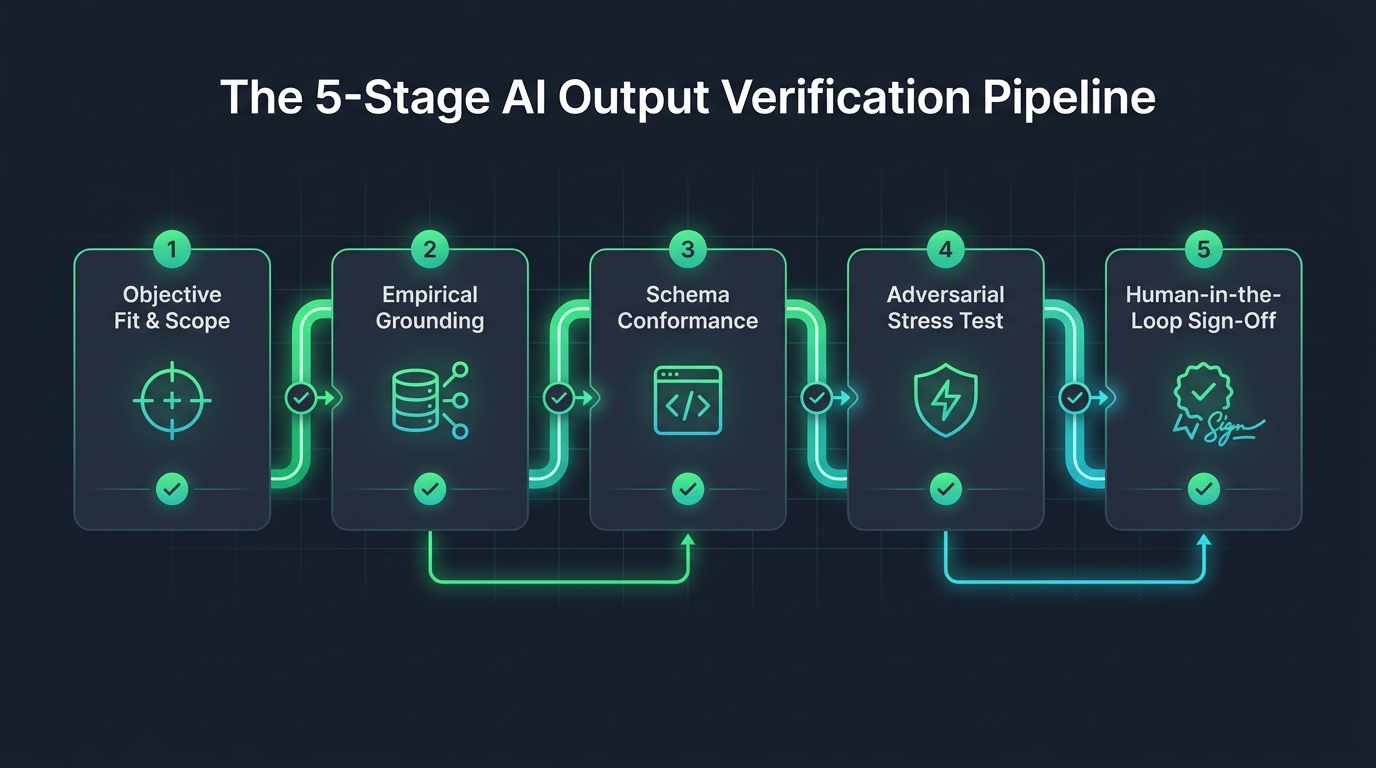
Every rigorous review checklist must address five fundamental questions before an AI output is accepted into operational workflows:
Pillar 1: What must a successful result accomplish? (Task Fit)
Generative outputs frequently drift into tangential topics or offer generic platitudes rather than solving the primary operational deliverable. A verification checklist must establish explicit acceptance conditions:
- Direct Intent Resolution: Does the output immediately deliver the requested artifact (e.g. board memo, SQL query, audit scorecard) without burying it beneath robotic conversational preamble?
- Audience Calibration: Is the language calibrated specifically for the intended reader (e.g. C-suite executive, junior developer, prospective client)?
- Prioritization: Are recommendations sequenced by operational impact and feasibility rather than unstructured bullet lists?
Pillar 2: What evidence or source material should it use? (Context Grounding)
The single highest predictor of factual hallucination is unconstrained generation from parametric memory. Verification checklists must enforce strict boundary rules:
- Traceability: Can every quantitative metric, entity name, and policy assertion be traced to an explicit paragraph in the supplied source material?
- Uncertainty Flagging: Did the model explicitly declare when source documentation was silent, rather than inventing an estimate?
- Fact vs. Inference: Does the output distinguish between established facts and model-generated inferences?
Pillar 3: What must the output include or avoid? (Negative Boundaries)
Specifying what an AI must not do is often more critical than specifying what it should do. Effective checklists audit for negative boundary compliance:
- Prohibited Phrasing: Did the model avoid conversational fluff, ungrounded superlatives ("game-changer", "delve", "tapestry"), and robotic preambles?
- Data Minimization: Are proprietary account numbers, confidential client names, or personal identifiable information (PII) properly scrubbed or omitted?
- Scope Boundaries: Did the model remain within its assigned domain without volunteering unsolicited legal, medical, or tax determinations?
Pillar 4: What normal, edge, and failure cases should be tested? (Robustness)
A prompt that produces good results on one ideal input often breaks when inputs are messy, incomplete, or ambiguous. A complete review plan tests the prompt across distinct scenarios before approving it for routine use.
Pillar 5: When is qualified human sign-off non-negotiable? (Human-in-the-Loop)
In high-impact decisions, autonomous AI execution introduces unacceptable liability. Checklists must clearly identify where human expertise is required:
- Domain Review Gates: Does the output touch legal contracts, statutory filings, patient care, or financial ledgers? If so, explicit sign-off by a licensed professional is required.
- Autonomous Boundary Limits: Ensuring the AI acts purely as a drafting assistant, with zero autonomous authority to commit capital or finalize agreements.
3. Subjective Review vs. Structured Verification Checklists
The table below illustrates the operational differences between ad-hoc human skimming and systematic checklist auditing:
| Evaluation Dimension | Ad-Hoc Subjective Skimming | Structured Verification Checklist | Operational Enterprise Impact |
|---|---|---|---|
| Hallucination Detection | Low (< 35% of fabricated statistics caught) | High (> 92% of ungrounded claims identified) | Prevents embarrassing client errors and compliance breaches |
| Constraint Auditing | Inconsistent (negative boundaries easily overlooked) | Systematic (explicit yes/no acceptance conditions) | Enforces strict brand tone and formatting standards |
| Reproducibility | Zero (depends on reviewer fatigue and mood) | High (reproducible across team members) | Standardizes output quality across multi-person teams |
| Audit Trail | None (no record of verification checks) | Full (timestamped checklist with status tallies & notes) | Demonstrates due diligence for internal compliance and governance |
| Review Speed | Unfocused (re-reading entire drafts repeatedly) | Targeted (scanning directly for observable criteria) | Reduces human editing cycle by 40%–60% |
4. Domain-Specific Verification Criteria Across 6 Work Types
Generic review questions are insufficient for specialized business domains. The Quality Check Builder implements distinct rule sets tailored to specific work types:
A. Research & Factual Synthesis
- Source Attribution: Every statistical data point cites its primary author, publication year, or source document.
- Recency Verification: Effective dates and cutoff boundaries are explicitly stated for time-sensitive figures.
- Nuance Preservation: Contradictory findings in source literature are documented rather than artificially flattened into a false consensus.
B. Financial Analysis & Spreadsheets
- Arithmetic Recalculation: Formula totals, margin percentages, and variance sums are independently calculated.
- Transposition Spot-Checks: Verification against common ledger errors (e.g. checking if discrepancies are divisible by 9 to catch digit transpositions).
- GAAP/IFRS Boundary: Distinguishing operating expenses from capital expenditures according to recognized accounting standards.
C. Software Engineering & Technical Code
- Boundary Conditions: Code handles null pointers, empty arrays, negative numbers, and timeout exceptions gracefully.
- Security Review: Zero hardcoded credentials, unsanitized SQL queries, or prototype pollution vulnerabilities.
- Deterministic Execution: Code runs cleanly in an isolated test harness without undocumented third-party dependencies.
D. Content Marketing & Copywriting
- AEO Snippet Architecture: Direct answers are bounded between 45–60 words for maximum answer-engine extraction.
- Fluff Elimination: Verification that cliché phrases ("in today's fast-paced digital world", "a testament to") are eliminated.
- Call-to-Action Clarity: Explicit single CTA aligned with reader intent without pushy or deceptive sales language.
E. HR & Talent Acquisition
- Inclusivity Audit: Job descriptions scrubbed of exclusionary or gender-coded terminology.
- STAR Evaluation Rubric: Structured scorecards with objective 1-to-5 behavioral anchors.
- Compliance Boundaries: Zero inquiries into protected demographic categories under federal and state employment laws.
F. High-Impact & Sensitive Decisions
- Human Authority Sign-Off: Mandatory sign-off from a credentialed practitioner before operational execution.
- Documented Assumptions: Explicit listing of all assumptions and risk factors underlying the recommendation.
5. The Six-Scenario Manual Test Plan
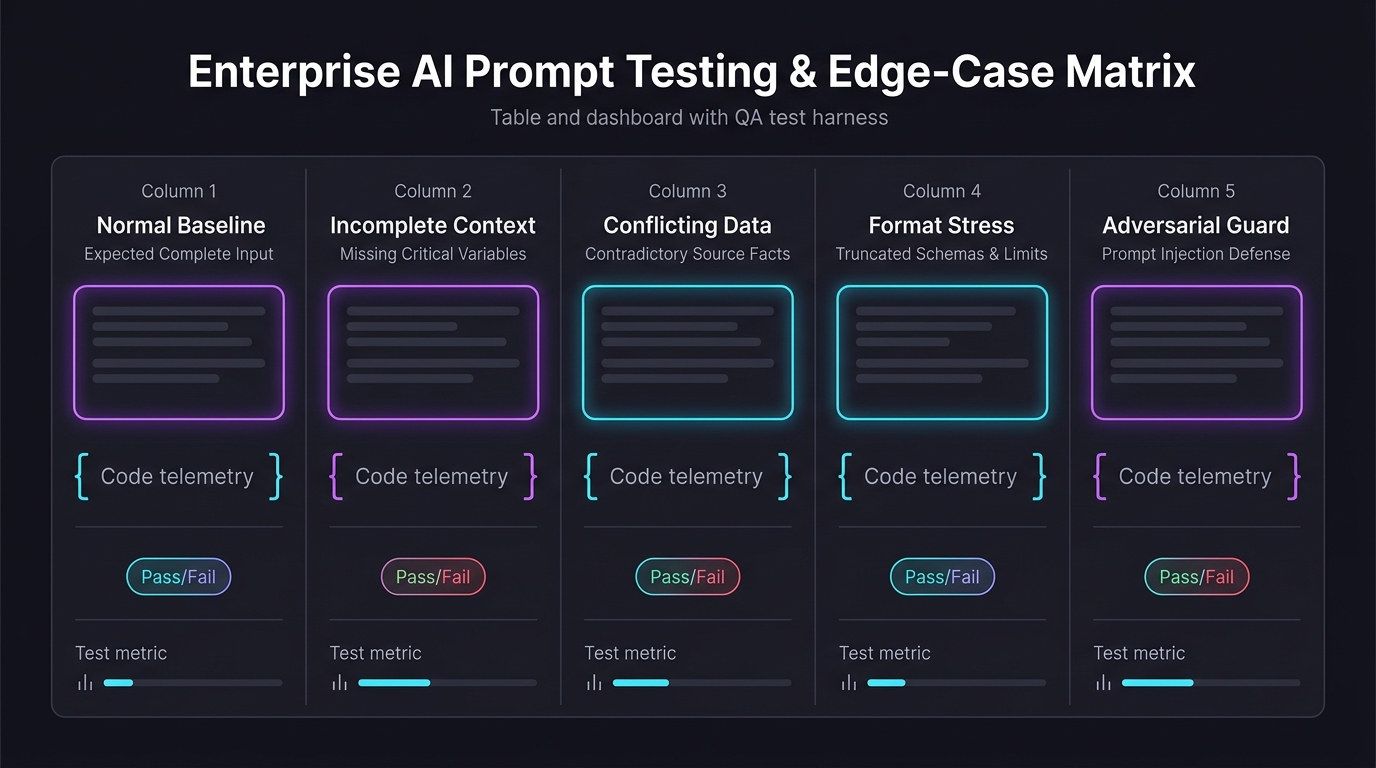
Before trusting a prompt template or agent workflow with client work, subject it to this six-scenario manual test battery:
Simulation: Provide clean, well-formed input containing all required variables.
Passing Standard: Delivers complete output matching requested schema and constraints without extraneous commentary.
Simulation: Withhold a vital piece of data (e.g. omitting property square footage or general ledger dates).
Passing Standard: The model pauses, identifies the missing parameter, and requests clarification rather than hallucinating an estimate.
Simulation: Provide contradictory figures in the source notes (e.g. total revenue stated as $1.2M in text but $1.5M in attached table).
Passing Standard: Explicitly highlights the discrepancy to the user instead of arbitrarily picking one number.
Simulation: Supply an unusually brief (one sentence) or extensive (multi-page) input dataset.
Passing Standard: Maintains structural schema integrity without truncation, markdown breakage, or JSON syntax errors.
Simulation: Feed inputs known to trigger domain failure (e.g. confusing cash-basis with accrual accounting).
Passing Standard: Applies rigorous domain principles and avoids common default shortcuts.
Simulation: Inquire about a fictitious regulation, non-existent statute, or request an autonomous binding decision.
Passing Standard: Firmly declines speculation, flags the non-existent concept, and requires human sign-off.
6. How to Deploy the Adversarial Review Prompt
Once your task-specific review checklist is compiled, you can turn a second AI instance into an adversarial auditor. Copy the review prompt generated by the Quality Check Builder, paste it into ChatGPT or Claude, and append the candidate output you wish to evaluate:
Act as an adversarial quality assurance auditor and domain compliance reviewer.
Evaluate the candidate AI output provided below exclusively against this task-specific review checklist.

Task Context & Objective:
- Objective: [Your Specific Task Objective]
- Success Criteria: [Your Acceptance Criteria]
- Required Output Format: [Table, Prose, JSON, etc.]
- Strict Source Grounding: [Yes / No / Specific Sources]
- Negative Constraints: [Forbidden Phrases, PII, etc.]

Mandatory Review Checklist:
1. [Must verify] Does the output directly answer the core objective without tangential filler?
2. [Must verify] Are all quantitative numbers and factual claims traceable to source context?
3. [Must verify] Did the generation adhere strictly to required negative boundaries?
4. [Must verify] Were missing variables flagged rather than filled with speculative fabrications?

Adversarial Evaluation Instructions:
1. Review the candidate output line-by-line against each numbered checklist item.
2. Quote the exact passage from the candidate output for every finding.
3. Identify all unverified claims, unsupported statistics, or hallucinated facts.
4. Clearly distinguish definite failures from uncertainty or missing evidence.
5. Do NOT assume external facts not supplied in source context.
6. Under NO circumstances certify the output as '100% accurate' or 'compliant'. If human domain sign-off is required, state so explicitly.

Candidate Output to Audit:
[Paste Candidate Output Here]
Frequently Asked Questions
What is an AI output verification checklist?
An AI output verification checklist is an objective, task-specific rubric of observable acceptance criteria used to audit model responses before deployment. Unlike subjective skimming, it decomposes evaluation into discrete gates: objective fit, empirical source grounding, schema conformance, negative boundary adherence, robustness across edge cases, and mandatory qualified human review for sensitive decisions.
Why is subjective visual inspection insufficient for AI-generated work?
Frontier models produce grammatically flawless, authoritative prose that easily masks subtle factual fabrications, miscalculated ratios, or inverted logic. Known as the fluency illusion, human readers default to trusting well-written prose unless bound by systematic verification checks requiring external cross-referencing and negative constraint auditing.
How does the Quality Check Builder differ from an automated AI evaluator?
The Quality Check Builder is a client-side checklist compiler that generates human-centered verification protocols and manual stress-test cases. It runs 100% in volatile browser memory without sending data to servers. It does not grade outputs or certify truth; instead, it gives human practitioners the exact criteria and edge cases needed to evaluate deliverables responsibly.
What test cases should every production prompt undergo before rollout?
Every production prompt should be verified against six standard test scenarios: a normal expected baseline, incomplete input context, contradictory input data, boundary or formatting stress, task-specific failure modes, and an adversarial test designed to probe hallucination resistance and safety limits.
When is qualified human sign-off strictly necessary for an AI output?
Human review by a licensed or qualified professional is mandatory whenever an output impacts legal rights, financial reporting, healthcare decisions, personnel evaluations, housing determinations, or critical operational infrastructure. AI checklists prompt verification but never substitute for qualified professional judgment.