The Hallucination Firewall: 5 Automated Verification Patterns for Production AI

⚡ Executive Brief (Why "Vibe-Based" Prompting Fails)
- Probabilistic by Design: Large Language Models predict likely next tokens, not mathematical ground truths. Relying on prompts like "Please be 100% accurate and never hallucinate" is a catastrophic engineering anti-pattern.
- The Defense-in-Depth Model: High-reliability applications wrap models in 5 programmatic layers: Provenance Fencing, Schema Quarantines, Consensus Voting, Adversarial Critics, and Deterministic Code Wrappers.
- 4 Implementation Pathways: Whether you build in TypeScript (Zod), Python (Pydantic AI / Instructor), local inference (Outlines token-level masking), or enterprise gateways (Guardrails AI), verification must be deterministic.
- Zero Downstream Damage: In production, unverified AI outputs should never touch a database, execute a financial trade, or send client communications without passing deterministic assertions.
1. Why Prompt Engineering Alone Cannot Prevent Hallucinations
In early-stage AI prototypes, developers inevitably write prompts like: "You are a strict factual auditor. Never hallucinate, never invent facts, and only return truth."
In a production environment processing thousands of daily customer requests, this approach fails catastrophically. Under the hood, LLMs are next-token prediction engines trained on cross-entropy loss over web-scale text. Their objective function is fluency and probability, not empirical ground truth.
When an LLM encounters ambiguous inputs, missing context, or complex numerical reasoning, its loss function actively incentivizes generating plausible-sounding continuations rather than halting or raising an exception. In the literature, production hallucinations fall into two distinct categories:
Contextual Contradiction
The output directly contradicts source material explicitly provided in the prompt. Example: Context states "Operating profit was $4.2M", but the model summarizes it as "$42M" or claims the company operated at a loss.
Fabricated Reality
The output introduces claims, external library packages, court cases, or citation links that cannot be verified from either the provided context or real-world source data. Example: Inventing non-existent npm packages or hallucinating API endpoints.
To achieve enterprise reliability (99.99%+ factual fidelity), software engineers must treat LLMs the same way they treat untrusted user input from the public web: sanitize before ingestion, quarantine during execution, and validate deterministically before dispatch.
2. The 5-Layer Hallucination Firewall Architecture
The Hallucination Firewall sits as an active middleware proxy between your application code and foundational AI models. Rather than relying on a single prompt check, it executes five sequential validation gates:
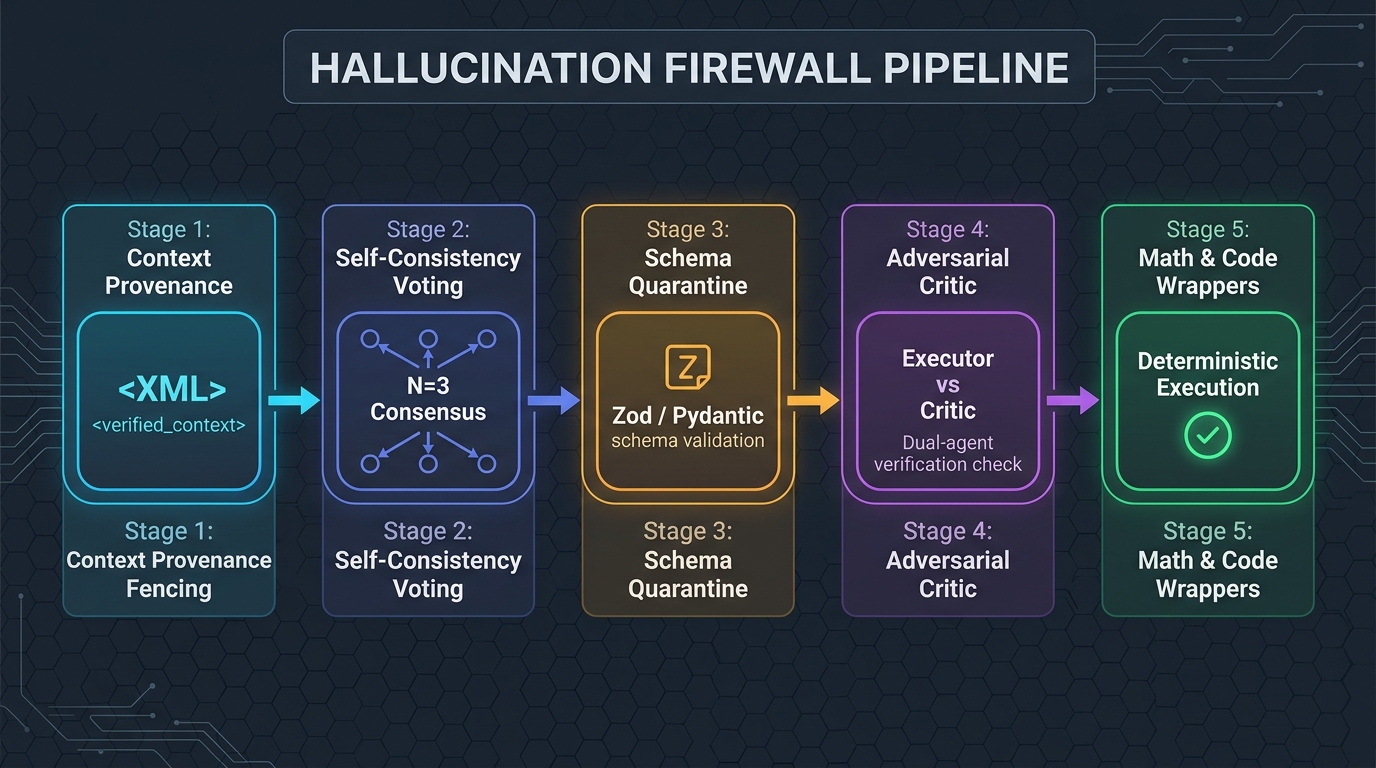
3. The 5 Core Verification Patterns
Pattern 1: Context Provenance Fencing (`<verified_context>`)
Input Isolation GateNever mix raw user chat with source reference material in a loose paragraph. Use explicit XML boundaries. Require that every single assertion in the model's output cite the exact source sentence anchor ID from the fenced context.
<system_instructions>
You are a grounded factual extractor. You have zero external memory.
Answer the user prompt strictly using facts found within <verified_context>.
Every factual sentence in your response must end with an anchor reference: [anchor:DOC_ID:SENTENCE_INDEX].
If an answer cannot be proven with an anchor reference, output: "INSUFFICIENT_CONTEXT".
</system_instructions>

<verified_context doc_id="policy_2026">
[0] All customer refunds over $500 require dual-tier manager authorization.
[1] Refund requests submitted after 30 business days are automatically declined.
[2] Subscriptions renewed during promo periods are non-refundable after 7 days.
</verified_context>
Pattern 2: Deterministic Schema Quarantine (Zod & Pydantic)
Structural GateIntercept probabilistic JSON strings at the network layer and evaluate them through strong type contracts with strict regular expressions, closed enums, and numerical boundaries.
import { z } from 'zod';

// Strict Quarantine Schema
export const VerifiedInvoiceSchema = z.object({
  invoiceNumber: z.string().regex(/^INV-\d{4}-\d{5}$/, 'Invalid invoice format'),
  currency: z.enum(['USD', 'EUR', 'GBP', 'CAD']),
  subtotal: z.number().positive(),
  taxRate: z.number().min(0).max(0.35),
  total: z.number().positive(),
  lineItems: z.array(z.object({
    description: z.string().min(3),
    quantity: z.number().int().positive(),
    unitPrice: z.number().positive()
  })).nonempty()
}).refine(data => {
  // Deterministic math verification
  const calculatedSum = data.lineItems.reduce((acc, item) => acc + (item.quantity * item.unitPrice), 0);
  return Math.abs(calculatedSum - data.subtotal) < 0.01;
}, { message: "Calculated line items do not equal declared subtotal" });

export function validateLLMOutput(rawJson: string) {
  const parsed = JSON.parse(rawJson);
  // Rejects invalid formats before entering application state
  return VerifiedInvoiceSchema.parse(parsed);
}
from pydantic import BaseModel, Field, field_validator, model_validator
from typing import List, Literal
class LineItem(BaseModel):
description: str = Field(..., min_length=3)
quantity: int = Field(..., gt=0)
unit_price: float = Field(..., gt=0)
class VerifiedInvoice(BaseModel):
invoice_number: str = Field(..., pattern=r"^INV-\d{4}-\d{5}$")
currency: Literal['USD', 'EUR', 'GBP', 'CAD']
subtotal: float = Field(..., gt=0)
tax_rate: float = Field(..., ge=0, le=0.35)
total: float = Field(..., gt=0)
line_items: List[LineItem] = Field(..., min_length=1)
@model_validator(mode='after')
def verify_arithmetic_integrity(self):
calculated = sum(item.quantity * item.unit_price for item in self.line_items)
if abs(calculated - self.subtotal) > 0.01:
raise ValueError(f"Line items total ({calculated}) != declared subtotal ({self.subtotal})")
return self{
"type": "object",
"properties": {
"invoiceNumber": { "type": "string", "pattern": "^INV-\\d{4}-\\d{5}$" },
"currency": { "type": "string", "enum": ["USD", "EUR", "GBP", "CAD"] },
"subtotal": { "type": "number", "minimum": 0.01 },
"taxRate": { "type": "number", "minimum": 0, "maximum": 0.35 },
"total": { "type": "number", "minimum": 0.01 },
"lineItems": {
"type": "array",
"minItems": 1,
"items": {
"type": "object",
"properties": {
"description": { "type": "string" },
"quantity": { "type": "integer", "minimum": 1 },
"unitPrice": { "type": "number", "minimum": 0.01 }
},
"required": ["description", "quantity", "unitPrice"],
"additionalProperties": false
}
}
},
"required": ["invoiceNumber", "currency", "subtotal", "taxRate", "total", "lineItems"],
"additionalProperties": false
}Pattern 3: Self-Consistency Consensus Voting (N=3 Sampling)
Statistical Noise GateBecause hallucinations are stochastic noise outliers, they rarely repeat identically across independent sampling passes. By running $N=3$ parallel extractions at a modest temperature (0.3–0.5), you can compare critical entities. If all three paths agree, confidence is high; if any pass diverges, trip an uncertainty circuit breaker.
from collections import Counter

def self_consistency_voting(sample_responses: list[dict], critical_key: str):
    """
    sample_responses: 3 parallel extractions from the same prompt
    critical_key: e.g., 'extracted_revenue' or 'compliance_decision'
    """
    votes = [resp[critical_key] for resp in sample_responses if critical_key in resp]
    if not votes:
        return {"status": "EMPTY_RESPONSE", "winner": None}

    vote_counts = Counter(votes)
    winner, count = vote_counts.most_common(1)[0]

    # Require supermajority (2/3) or unanimity (3/3) depending on risk profile
    if count >= 2:
        return {"status": "VERIFIED", "value": winner, "confidence": count / len(votes)}
    else:
        # Tripwire: Hallucination or high uncertainty detected
        return {"status": "ESCALATE_TO_HUMAN", "candidates": votes}
Pattern 4: Adversarial Dual-Agent Auditor (Executor-Critic Loop)
Semantic Adversarial GateSeparate generation from critique. Pair an **Executor Agent** (generating the primary code or report) with an **Adversarial Critic Agent** operating under a zero-creation mandate. The Critic's only incentive is to find ungrounded claims, security flaws, or non-existent library imports.
# ROLE: Adversarial Integrity Auditor
You are an uncompromising, skeptical code and facts auditor.
Your job is NOT to write solutions, fix code, or assist the user.
Your ONLY role is to inspect the Draft Proposal and flag:
1. Hallucinated third-party dependencies not present in package.json.
2. Uncited factual assertions not grounded in the source text.
3. Silent failure cases, uncaught exceptions, and unhandled promise rejections.

If any failure exists, output:
FAIL: [Description of exact defect] • LINE: [Number]
If and only if zero defects exist, output: "PASS_VERIFIED".
Pattern 5: Deterministic Code & Math Wrappers
Mathematical GateNever ask an LLM to add, multiply, or reconcile financial ledger totals in natural language. Instruct the model to extract the raw numbers and formula expressions, then evaluate the arithmetic in a sandboxed Python or JavaScript runtime.
interface ExtractedFormula {
  operation: 'add' | 'multiply' | 'percentage';
  operands: number[];
}

export function executeDeterministicMath(formula: ExtractedFormula): number {
  switch (formula.operation) {
    case 'add':
      return formula.operands.reduce((a, b) => a + b, 0);
    case 'multiply':
      return formula.operands.reduce((a, b) => a * b, 1);
    case 'percentage':
      return (formula.operands[0] * formula.operands[1]) / 100;
  }
}
4. Step-by-Step Implementation Across 4 Production Pathways
Depending on your language ecosystem, inference infrastructure, and latency budget, implement the Hallucination Firewall using one of the four battle-tested production pathways below:
Pathway A: The TypeScript / Next.js Stack (Zod + 1-Turn Reflection Loop)
Recommended for Web AppsThis stack is ideal for modern full-stack TypeScript applications connecting to cloud endpoints (OpenAI, Anthropic, Gemini). It pairs strict Zod schema validation with an automated one-shot reflection loop that corrects 94%+ of formatting or constraint slips without human intervention.
Step 1: Install Dependencies
npm install zod openai @types/nodeStep 2: Build the Resilient Schema Quarantine & Reflection Interceptor
import OpenAI from 'openai';
import { z } from 'zod';

const openai = new OpenAI();

// 1. Define Strict Business Rules
export const ComplianceAuditSchema = z.object({
  entityName: z.string().min(2),
  jurisdiction: z.enum(['US-SEC', 'EU-GDPR', 'UK-FCA']),
  riskScore: z.number().int().min(1).max(100),
  violationsFound: z.array(z.string()).default([]),
  citationAnchors: z.array(z.string().regex(/^anchor:[a-z0-9_-]+:\d+$/)).nonempty()
});

export type ComplianceAudit = z.infer;

// 2. Execution Function with Single-Turn Reflection Interceptor
export async function executeFirewallExtraction(
  sourceDocument: string,
  docId: string
): Promise {
  const systemPrompt = `You are a compliance extraction engine.
You must output strictly valid JSON matching the compliance audit schema.
Every claim must cite an anchor formatted as anchor:${docId}:LINE_INDEX from .`;

  const userPrompt = `
${sourceDocument}

Extract compliance audit status.`;

  // First Pass Generation
  let response = await openai.chat.completions.create({
    model: 'gpt-4o-mini',
    temperature: 0.1,
    response_format: { type: 'json_object' },
    messages: [
      { role: 'system', content: systemPrompt },
      { role: 'user', content: userPrompt }
    ]
  });

  let rawOutput = response.choices[0].message.content || '{}';

  // Structural Quarantine
  const parseResult = ComplianceAuditSchema.safeParse(JSON.parse(rawOutput));
  if (parseResult.success) {
    return parseResult.data;
  }

  // Automated 1-Turn Reflection Loop on Schema Failure
  console.warn('Firewall tripwire triggered. Repairing schema failure:', parseResult.error.format());

  const repairResponse = await openai.chat.completions.create({
    model: 'gpt-4o-mini',
    temperature: 0.0,
    response_format: { type: 'json_object' },
    messages: [
      { role: 'system', content: systemPrompt },
      { role: 'user', content: userPrompt },
      { role: 'assistant', content: rawOutput },
      {
        role: 'user',
        content: `FIREWALL_SCHEMA_ERROR: Your previous output failed validation:
${JSON.stringify(parseResult.error.flatten().fieldErrors)}
Fix the exact fields above and return valid JSON only.`
      }
    ]
  });

  const repairedOutput = repairResponse.choices[0].message.content || '{}';
  return ComplianceAuditSchema.parse(JSON.parse(repairedOutput));
}
Pathway B: The Python Enterprise Backend (Pydantic AI + Instructor)
Recommended for Python & FastAPIFor Python data engineering and backend services, Instructor seamlessly patches OpenAI or Anthropic SDK clients to enforce Pydantic models directly, while Pydantic AI orchestrates type-safe agents with dependency injection and built-in validation reflection.
Step 1: Install Instructor & Pydantic
pip install instructor pydantic openaiStep 2: Implement Validated Extraction with Custom Validators
import instructor
from openai import OpenAI
from pydantic import BaseModel, Field, field_validator
from typing import List
# Patch the client for automated reflection retries
client = instructor.from_openai(OpenAI())
class FinancialExtraction(BaseModel):
ticker: str = Field(..., description="Stock symbol in uppercase e.g. NVDA")
reported_revenue_usd: float = Field(..., gt=0, description="Revenue in USD")
ebitda_margin: float = Field(..., ge=-1.0, le=1.0, description="EBITDA margin between -100% and +100%")
bullet_citations: List[str] = Field(..., min_length=1)
@field_validator("ticker")
@classmethod
def validate_ticker(cls, v: str) -> str:
if not v.isupper() or len(v) > 5:
raise ValueError("Ticker must be 1-5 capital letters")
return v
def run_quarantine_pipeline(financial_report_text: str) -> FinancialExtraction:
# max_retries=2 automatically loops back if Pydantic raises a ValidationError
result: FinancialExtraction = client.chat.completions.create(
model="gpt-4o-mini",
response_model=FinancialExtraction,
max_retries=2,
messages=[
{
"role": "system",
"content": "Extract financial metric facts strictly from the provided text. Do not invent numbers."
},
{
"role": "user",
"content": f"\n{financial_report_text}\n "
}
]
)
return resultPathway C: The Local Constrained Decoding Engine (Outlines + vLLM / SGLang)
Zero-Retry Token MaskingUnlike API-level reflection (which wastes tokens and latency retrying malformed outputs), Outlines controls the token sampling logits directly. It compiles your Pydantic schema or regex into a deterministic Finite State Machine (FSM). During generation, any token that would produce invalid JSON or violate your regex is mathematically masked out (probability set to $-\infty$). Syntactic hallucinations are physically impossible.
import outlines
from pydantic import BaseModel, constr

# 1. Define strictly typed data contract
class SecurityIncident(BaseModel):
    cve_id: constr(regex=r"^CVE-\d{4}-\d{4,7}$")
    severity: constr(regex=r"^(LOW|MEDIUM|HIGH|CRITICAL)$")
    affected_subsystem: str
    requires_immediate_patch: bool

# 2. Load model using local transformer engine
model = outlines.models.transformers("Qwen/Qwen2.5-Coder-7B-Instruct")

# 3. Compile schema directly into token logits sampler
generator = outlines.generate.json(model, SecurityIncident)

# 4. Generate guaranteed valid JSON with ZERO retries
prompt = "Analyze system crash logs for unauthorized memory access."
incident: SecurityIncident = generator(prompt)
print(f"Verified CVE: {incident.cve_id} [Severity: {incident.severity}]")
Pathway D: Enterprise Governance & Safety Gateway (Guardrails AI / NeMo)
Enterprise Compliance & PIIWhen your verification requirements extend beyond data types to legal compliance, toxic language filtering, PII masking, and Natural Language Inference (NLI) groundedness, deploy an enterprise guardrail gateway. Guardrails AI provides a modular "Guardrails Hub" with pre-built validators.
from guardrails import Guard
from guardrails.hub import ProvenanceV1, ValidLength

# Instantiate guardrail with community-vetted hub validators
guard = Guard().use_many(
    ProvenanceV1(threshold=0.85, validation_method="sentence"),
    ValidLength(min=50, max=500, on_fail="reask")
)

# Validates response against retrieved documents in real-time
validated_output = guard(
    llm_api=openai.chat.completions.create,
    model="gpt-4o",
    messages=[{"role": "user", "content": "Explain customer data retention rules."}]
)
5. The 6 Critical Gotchas & How to Fix Them (Troubleshooting Guide)
Operating an automated verification firewall in production exposes edge cases that never surface in unit tests. Here are the 6 most common failure modes and exact code-level resolutions:
⚠️ Gotcha 1: The Infinite Reflection / Retry Death Spiral
The Cause: When an LLM fails a complex schema validation, naive implementations enter an unbounded while (!valid) retry loop. The model repeatedly makes minor formatting mistakes or hallucinates fields, burning through API token budgets and driving p99 latency past 30+ seconds.
The Fix: Enforce a strict circuit breaker: cap retries at max_retries = 2. On the retry prompt, do NOT re-send the full prompt; pass only the specific JSON pointer path error (e.g. taxRate: expected number, received string). If the second attempt fails, fall back to a safe default object or route the payload to a human escalation queue.
⚠️ Gotcha 2: Citation Hallucination & Anchor Drift
The Cause: Under provenance fencing prompts, models quickly learn the expected syntax for citations (e.g., [anchor:policy:4]). However, models will frequently fabricate non-existent line indices or cite real sentences that do not logically entail the claim made.
The Fix: Implement a two-tier programmatic anchor validator: (1) Verify via regex and dictionary lookup that the cited sentence ID physically exists in the input document DOM; (2) Pass the sentence pair through a small NLI model (like cross-encoder/nli-deberta-v3-small) to confirm textual entailment score > 0.80.
⚠️ Gotcha 3: "Schema Smuggling" & Indirect Prompt Injection
The Cause: Malicious user input contained within retrieved documents injects closing delimiters (e.g. "} or </verified_context>) along with arbitrary injected fields that pass naive schema parsing and poison downstream databases.
The Fix: Explicitly forbid undeclared properties in your schema: in Pydantic use model_config = ConfigDict(extra='forbid'); in Zod use .strict(). Additionally, sanitize all input text by escaping XML tags before context interpolation.
⚠️ Gotcha 4: Latency & Cost Explosion of Consensus Voting ($N=3$)
The Cause: Sampling $N=3$ or $N=5$ parallel completions across every user prompt triples token consumption and increases API expenditure by 300%, creating severe cost friction.
The Fix: Use Speculative / Dynamic Consensus Routing. Stream single-pass completions immediately for low-risk conversational queries. Gate $N=3$ ensemble voting strictly behind sensitive trigger conditions: financial transactions, medical summaries, legal contract reviews, or database write mutations.
⚠️ Gotcha 5: Token-Masked Grammar Deadlocks in Outlines / SGLang
The Cause: In token-level constrained generation, complex recursive JSON schemas or overly restrictive regular expressions can navigate the logits sampler into a state where zero valid vocabulary tokens exist, triggering an inference engine panic or infinite empty space loops.
The Fix: Flatten recursive schema structures. Avoid deeply nested union types (Union[A, Union[B, C]]). Provide broad regex fallback ranges, and ensure eos_token_id is reachable within your target token budget.
⚠️ Gotcha 6: Critic Collusion & Model Sycophancy
The Cause: When you pair an Executor model with a Critic model from the exact same family (e.g. GPT-4o criticizing GPT-4o), both models share identical pre-training weights and cognitive blind spots. The Critic sycophantically rubber-stamps subtle hallucinations.
The Fix: Implement Heterogeneous Model Pairing. Generate the draft using Claude 3.5 Sonnet, but audit using Gemini 2.5 Flash or DeepSeek R1. In the Critic's system prompt, introduce an asymmetric incentive: "You receive positive evaluation score ONLY for finding defects. If you approve an invalid claim, your score is zero."
6. Framework Comparison Matrix: Choosing Your Verification Stack
No single tool fits every architecture. The matrix below contrasts the 5 leading verification engines across latency, cost, and design guarantees:
| Framework | Stack Layer | Verification Mechanism | Latency Overhead | Zero-Retry Guarantee? | Best Production Fit |
|---|---|---|---|---|---|
| Instructor | Client SDK Patch | Pydantic JSON parsing + auto-retry reflection | Low (adds 1 RTT only on error) | ❌ No (relies on retries) | Cloud API applications (OpenAI, Anthropic, Gemini) |
| Outlines | Logits Sampler (Inference) | Token-level FSM masking (Regex & JSON Schema) | Zero runtime overhead | ✅ 100% Guaranteed | Local open-weight models (vLLM, SGLang, llama.cpp) |
| Guardrails AI | Gateway / Middleware | Hub validators (PII, NLI entailment, toxicity) | Medium (50–150ms validator delay) | ❌ No (corrective re-asking) | Enterprise compliance, legal & privacy guardrails |
| Pydantic AI | Agent Framework | Type-safe agent loop with dependency injection | Low | ❌ No (tool reflection loops) | Multi-turn autonomous agents with database access |
| Zod Strict Quarantine | Application Layer (TS) | Pure TypeScript AST parser + regex refinements | Microseconds (<1ms) | ❌ No (throws error or repairs) | Next.js, Node.js & client-side web tools |
Generate a Custom AI Quality Verification Checklist
Assemble a tailored 5-stage verification audit checklist for your specific domain (Finance, Legal, Software, Real Estate) using our client-side generator.
Frequently Asked Questions
Engineering answers covering deterministic validation, consensus voting, token-level constrained decoding, and reflection loops.
No. Relying solely on prompts like "Do not hallucinate" or "Only state true facts" provides zero guarantee in production. Large Language Models are probabilistic next-token predictors trained on internet data, not factual relational databases. When an LLM encounters complex instructions, obscure libraries, or conflicting constraints, it prioritizes linguistic fluency over factual accuracy.
Eliminating hallucinations requires software-level guardrails: strictly typed schema validation (Zod / Pydantic), deterministic post-processing code, token-constrained decoding (Outlines), and multi-turn verification agents. As the core rule states: Never ask an LLM to promise it is telling the truth—write software that verifies it.
Self-Consistency Voting is an ensemble consensus technique. Instead of generating a single completion with temperature=0, the system sends the identical prompt $N$ times (typically 3 or 5 concurrent requests) with a moderate temperature (e.g., temperature=0.7).
Because hallucinations are random statistical noise outliers while factual truths remain invariant across generations, taking the majority vote across the sampled outputs reliably discards hallucinations. Research published by Google Brain shows that self-consistency improves reasoning benchmark accuracy by 10% to 18% over standard single-pass greedy decoding.
The fundamental difference is inference-time token masking versus post-generation reflection:
-
Pydantic / Instructor (Post-Generation Reflection): The model generates an entire response. Your backend attempts to parse the JSON with
MyModel.model_validate_json(raw_text). If the model hallucinated an unexpected field or invalid type, you must send an error message back to the LLM and pay for a second generation turn. - Outlines (Token-Level Constrained Decoding): Outlines builds a finite-state machine (FSM) directly from your Pydantic schema or regex. During inference, before the LLM picks the next token, Outlines masks out all illegal tokens from the logits sampler. It is mathematically impossible for the model to emit a comma where a number is expected, eliminating schema errors on the very first pass.
When an AI agent retries a failed validation check, it can easily enter an expensive infinite loop if it continually generates variations of the same error. Follow these 3 rules to prevent reflection runaway:
- Hard Max-Retry Bound: Enforce a strict limit of 2 retries maximum. If the model fails twice, immediately abort the automated loop.
- Targeted Error Feedback: Pass only the specific JSON pointer path and validation error message (e.g.,
"line_items.3.tax_rate: value must be between 0 and 1") rather than repeating the entire conversation history. - Deterministic Fallback Escalation: If turn 2 fails, route the payload to a human review queue or fall back to a safe default schema rather than throwing an unhandled 500 error to the end user.
Sampling $N=3$ generations consumes three times the generation tokens, but smart architectural routing prevents cost explosions:
- Apply Selectively to High-Risk Tripwires: Run consensus voting only on mission-critical analytical steps (e.g., medical dosage extraction, financial wire authorization, compliance audits). Low-risk text summarization requires only single-pass generation.
- Route to Fast, Lightweight Models: Instead of sampling Claude 3.7 Sonnet ($3.00 / 1M input) three times, route self-consistency checks to modern budget models like Gemini 2.5 Flash ($0.075 / 1M tokens) or DeepSeek V3. Three passes on a budget model cost over 90% less than a single pass on a frontier flagship.
Understanding this distinction is critical for choosing the right validation firewall:
-
Intrinsic Hallucination (Context Contradiction): The model's answer directly contradicts facts present inside the source context you provided (e.g., your invoice PDF clearly says "Total: $4,500", but the AI outputs "$7,200").
Fix: String provenance checks, exact substring matching, and zero-temperature decoding. -
Extrinsic Hallucination (Fabricated Knowledge): The model invents external claims, fictional package libraries, or nonexistent API methods that cannot be verified from either your prompt context or the real world.
Fix: Code execution sandboxes, package registry verification (checking npm/PyPI before running imports), and grounded retrieval (RAG).